Greek cuisine is one of the oldest in the world and one of the most influential — the foundation of the entire Mediterranean diet. It is built on a short list of exceptional ingredients: olive oil (Greece produces 20% of the world's supply), fresh vegetables, legumes, seafood from the Aegean and Ionian Seas, sheep and goat dairy, and herbs like oregano, thyme, and dill. Greek food is honest, seasonal, and deeply social — meals are long, loud, and shared. This guide covers the 10 must-try Greek foods and drinks, where to find them at their best, and what to pay.
Greece Food Quick Facts• Currency: Euro (EUR)
• Budget meal: EUR 6-12 | Mid-range taverna: EUR 15-30 per person | Upscale: EUR 40+
• Meal times: Lunch 2-4pm | Dinner 9-11pm (Greeks eat late)
• Tipping: Round up or leave 5-10% — appreciated but not expected
• Meze culture: Order many small dishes to share — this is the authentic way to eat
1. Moussaka
Greece's most internationally recognised dish is a baked casserole of alternating layers: sliced eggplant (sometimes potato), spiced minced lamb or beef cooked in tomato and cinnamon, and a thick, oven-browned béchamel topping. The cinnamon and allspice in the meat — a legacy of Byzantine and Ottoman spice trade routes — is what gives moussaka its distinctive warmth. A proper moussaka is made the day before and reheated to let the flavours meld; restaurants that make it fresh to order are either very skilled or cutting corners.
Where to eat: Taverna tou Psara (Athens, Plaka) for a classic version; Kentrikon (Athens, Syntagma) for a refined take; any family-run taverna outside tourist centres — the further from the Acropolis, the better the moussaka.
Price range: EUR 8-14 at a taverna | EUR 18-28 at a restaurant.
Pro tip: Moussaka served at room temperature rather than scalding hot is usually made properly — it needs to rest so it holds its layers when cut. Burning hot moussaka is often microwaved.2. Souvlaki & Gyro
These are Greece's everyday fast food — and among the best versions of it anywhere in the world. Souvlaki is small cubes of pork or chicken skewered and grilled over charcoal, served in a warm pita with tzatziki, tomato, onion, and paprika-dusted fries (in Athens) or on a plate with salad and lemon potatoes (in the islands). Gyro is pork or chicken cooked on a vertical rotisserie and shaved to order — the difference between a fresh gyro and one that has been sitting is enormous. Athens has an ongoing souvlaki rivalry between shops; locals have fierce loyalty to their neighbourhood place.
Where to eat: Thanasis (Athens, Monastiraki) for one of the city's most debated souvlakis since 1898; Kostas (Athens, Plateia Agia Irini) for minimalist perfection; any grill house in the islands open after midnight serving the late-night crowd.
Price range: EUR 3-4 for a pita | EUR 7-12 for a full souvlaki plate.
3. Horiatiki (Greek Salad)
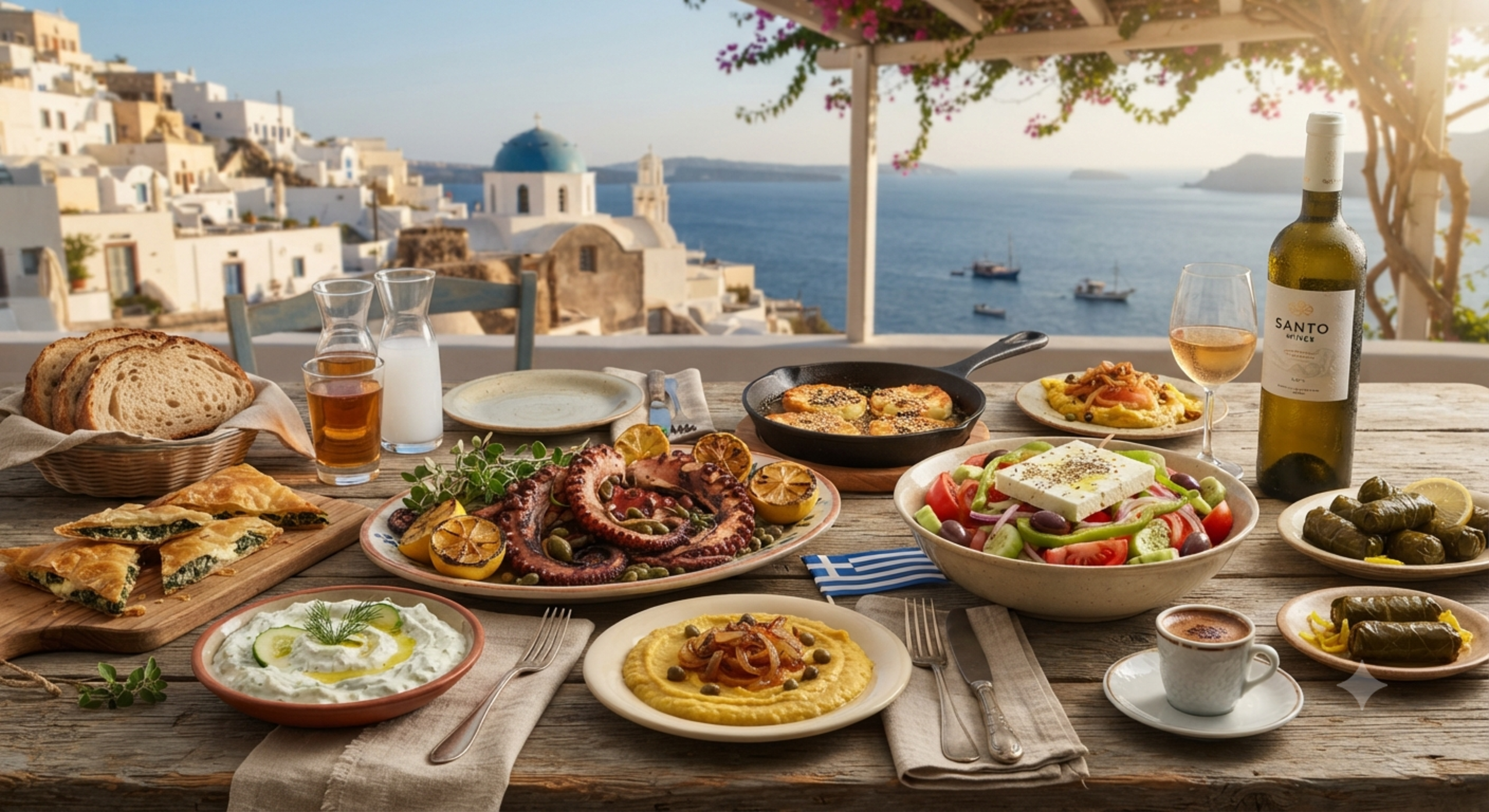
The real Greek salad has no lettuce — it is a riot of chunky-cut ripe tomatoes, thick cucumber slices, Kalamata olives, green pepper, and red onion, topped with a large slab (not crumbled) of barrel-aged feta PDO, drenched in cold-pressed Greek olive oil, and finished with dried oregano. The quality of the tomatoes — best in August, grown in thin-soiled Greek earth under intense sun — is everything. The feta must be Greek PDO feta (sheep and goat milk) to be genuine; Bulgarian-style white cheese is not feta.
Where to eat: Any taverna in Greece during summer; the tomatoes from Santorini (small, intensely flavoured due to volcanic soil and minimal rainfall) make the best Greek salad on the island of the same name.
Price range: EUR 7-12 at a taverna.
4. Spanakopita & Tiropita
Two of Greece's most beloved pies: spanakopita (spinach and feta in buttered filo pastry, baked until shatteringly crisp) and tiropita (feta and egg custard in filo). These are eaten for breakfast, as snacks, and as starters. The filo technique — up to 40 tissue-thin layers of dough brushed with butter or olive oil — requires considerable skill; homemade filo from a village baker collapses into flavour in a way that commercial filo cannot match. Sold at every bakery (fournos) in Greece from early morning.
Where to eat: Ariston (Athens, since 1910) for legendary tiropita; any village bakery at 7am for freshly baked spanakopita; the market of Thessaloniki for exceptional pies from the city known for its food culture.
Price range: EUR 1.50-3.50 per slice at a bakery | EUR 5-8 as a starter at a taverna.
5. Fresh Grilled Seafood
With 16,000 km of coastline and thousands of islands, seafood is central to the Greek table. The traditional approach is simple: whole fish grilled over charcoal, finished with ladolemono (olive oil and lemon), and served with a side of horta (wild greens). Octopus hammered against rocks, sun-dried, then charcoal-grilled and drizzled with vinegar is as quintessentially Greek as anything. Seafood in Greece is priced by weight — always check before ordering, especially at tourist-facing restaurants.
Where to eat: Bakaliarakia tou Damigou (Athens, oldest seafood restaurant in the city, underground since 1865); the fishing villages of the Pelion Peninsula and Crete for the freshest daily catch; the port of Naoussa (Paros) for exceptional grilled octopus at sunset.
Price range: EUR 12-20 per 100g for whole fish | EUR 10-18 for a grilled octopus portion | EUR 8-14 for calamari.
6. Dolmades
Grape vine leaves stuffed with a filling of rice, fresh herbs (mint, dill, parsley), onion, and lemon — either "yalantzi" (meatless, served cold with lemon and olive oil) or with minced lamb and served hot with avgolemono (egg-lemon sauce). The vine leaves themselves have a distinctive bitter-sour tang that contrasts with the fragrant rice filling. Dolmades made with fresh vine leaves in late spring are measurably better than those made with preserved leaves used year-round; village women still make them by hand for Sunday meals.
Where to eat: Any meze restaurant (mezedopoleio) as part of a spread; Epirus region of northwestern Greece for the most traditional version; Cretan tavernas for herb-heavy variations.
Price range: EUR 6-10 for a portion as meze.
7. Ouzo
Greece's national spirit is a clear anise-flavored distillate of grape pomace and herbs — when water or ice is added, it turns milky white (the "louche" effect) and becomes softer in flavour. It is never drunk on an empty stomach; ouzo is always accompanied by small plates of meze — olives, cheese, octopus, fried fish. The island of Lesvos produces ouzo considered the best in Greece (particularly Mini and Plomari brands). Drinking ouzo quickly or as a shot is considered uncultured — it is meant to be sipped slowly over two hours with food and conversation.
Where to drink: Any ouzeri (ouzo bar) in Lesvos; Brettos (Athens, oldest distillery bar in the city since 1909) for ouzo among hundreds of bottles floor to ceiling; any beach taverna in the islands from noon onward.
Price range: EUR 3-6 for a glass with meze at an ouzeri.
Pro tip: Never add ouzo to a glass of water — always pour the ouzo first, then add water and ice. Adding ice first then ouzo "kills" the spirit according to Greeks, and they will tell you.8. Greek Wine — Assyrtiko & Retsina
Greece has over 300 indigenous grape varieties that exist nowhere else in the world, making it one of the most exciting wine countries for serious drinkers. Assyrtiko from Santorini is the flagship — a bone-dry, mineral, high-acid white grown in volcanic ash soil with almost no rainfall, producing intense citrus and saline flavours. Xinomavro from Naoussa (northern Greece) is the great red — tannic, complex, and capable of aging for decades. Retsina (white wine preserved with pine resin, an ancient technique) is an acquired taste but worth trying once with grilled fish.
Where to drink: Santo Wines (Santorini, with a caldera view) for premium Assyrtiko tasting; Domaine Skouras (Nemea, Peloponnese) for excellent Agiorgitiko red; any taverna in Naoussa (Macedonia) for Xinomavro directly from the producer.
Price range: EUR 4-8 per glass of house wine at a taverna | EUR 15-40 for a bottle of premium Assyrtiko.
9. Baklava & Loukoumades
Greek sweets carry Ottoman and Byzantine influences. Baklava — layers of filo, crushed walnuts and pistachios, and drenching honey syrup, cut into diamond shapes — is found across Greece but has its most refined versions in Thessaloniki and Ioannina, where pastry shops (zacharoplastia) have generations of expertise. Loukoumades are ancient: small yeasted dough balls deep-fried and drizzled with honey, cinnamon, and crushed walnuts — historians believe they were given to Olympic athletes as prizes. Hot loukoumades from a street stall at midnight need no further context.
Where to eat: Terkenlis (Thessaloniki, since 1948) for exceptional baklava; Loukoumades Flocafe or street stalls outside markets for fresh loukoumades; Karavan (Thessaloniki) for a full assortment of Greek pastries.
Price range: EUR 3-6 for a baklava slice | EUR 4-7 for a portion of loukoumades.
10. Greek Coffee (Ellinikos Kafes)
Finely ground coffee (identical to Turkish coffee but called "Greek" for obvious geopolitical reasons) brewed slowly in a small copper or brass pot called a briki, poured grounds and all into a small cup, and served with a glass of cold water. The sediment settles as you drink; never drain the cup completely. Three levels of sweetness: "sketo" (unsweetened), "metrio" (one teaspoon of sugar), "glyko" (very sweet). In summer, the frappé — instant Nescafe blended with ice water into cold foam — is the everyday drink of Greeks everywhere.
Where to drink: Any kafeneion (traditional coffee house) — these are the social centres of every Greek village and neighbourhood; sit and order a metrio Greek coffee for EUR 1.50 and you can stay for hours.
Price range: EUR 1.50-2.50 for Greek coffee | EUR 2-4 for a frappé.
Experience Greek Food Culture with a Local GuideAthens and Thessaloniki are exceptional cities for food walking tours — covering the central market, meze bars, street food stalls, and wine shops in a single morning or evening.
Athens Food Tours on GetYourGuide | Greek Food Experiences on Viator
Eating & Drinking in Greece: What to Know
- Meze is the style: Order many small shared dishes rather than individual mains — this is how Greeks eat. A meze spread for four people with drinks is the ideal way to experience Greek food.
- Tavernas outside tourist areas: Walk 10 minutes from the main square of any town and prices drop by 30-40% with quality going up. Greeks do not eat where tourists eat.
- Seafood is by weight: Always confirm the weight of your fish before it is cooked — a 600g sea bass at EUR 55/kg is EUR 33 before sides and wine. Not a trap if you know in advance.
- Eat late: Greeks have dinner at 9-10pm. Going to a taverna at 7pm means you will be alone and the kitchen will be cold. Arrive at 9pm and you join the real evening.
- House wine from the barrel: Many tavernas serve wine from their own barrel — ask for "hima" (bulk wine). It is often excellent, always cheap (EUR 5-8 per half-litre carafe), and gives you a connection to the local terroir.