
The world is far stranger, more extreme, and more fascinating than any map or classroom can convey. Travel facts are not just trivia — they are windows into the logic of places, the quirks of cultures, and the sheer improbability of the planet we live on. From a country where everyone can legally live without a visa to a city where stepping on a coin is a criminal offence, these 25 facts will make you see familiar destinations differently and inspire you to explore ones you have never considered.
Each fact below is verified, contextualised, and — where relevant — connected to what it means for you as a traveler. Read on, and see how many genuinely surprise you.
🌍 How many did you already know?0-5: The world has been hiding a lot from you. Time to explore.
6-12: You are a curious and well-traveled mind. Keep going.
13-20: Impressively well-informed. Share these facts with someone who needs them.
21-25: You are either a geography teacher or you have been everywhere.
🌊 Geography and Natural Records
1. Canada has more lakes than the rest of the world combined. Canada contains approximately 879,800 lakes — representing around 62% of all lakes on Earth. The exact number depends on the minimum size counted, but no other country comes close. Many of these lakes have never been named, let alone visited. For travelers, this means that even Canada's "crowded" wilderness areas contain genuinely unexplored corners.
2. Antarctica is the world's largest desert. Despite being covered in ice, Antarctica receives less precipitation than the Sahara — just 200 mm per year on the coast and almost none in the interior. Deserts are defined by precipitation, not temperature. Antarctica is also the driest, coldest, and windiest continent on Earth — and the only one with no permanent human population. A continent that is simultaneously the world's largest desert and its largest freshwater reserve (holding 70% of Earth's fresh water as ice) is about as paradoxical as geography gets.
3. Saudi Arabia is the largest country in the world without a permanent river. The Arabian Peninsula's geology and climate mean that all water comes from aquifers, desalination plants, and seasonal wadis (riverbeds that flow only after rare rainfall). Saudi Arabia now desalinates more seawater than any other country — about 20% of the world's total. For travelers, this makes the kingdom's rare oases and the Asir Mountains in the southwest (where it can actually rain) all the more striking by contrast.
4. Russia spans 11 time zones. Flying from Moscow to Vladivostok on Russia's far east coast takes approximately 9 hours — about the same as flying from London to New York. But while London and New York are 5 time zones apart, Moscow and Vladivostok are 7. Russia is so wide that it covers more east-west distance (9,000 km) than the entire Moon is wide (3,474 km). Travelers on the Trans-Siberian Railway cross all 11 time zones over 6 days — one of the great slow-travel experiences on Earth.
5. Australia is wider than the Moon. Australia's east-to-west span is approximately 4,000 km. The Moon's diameter is 3,474 km. Despite feeling "small" on a world map (due to Mercator projection distortion), Australia is the sixth-largest country in the world and comparable in size to the continental United States. The distances between Australian cities are so vast that flying from Sydney to Perth takes as long as flying from London to Cairo.
6. Finland has more lakes per square kilometre than any country on Earth. Finland has approximately 188,000 lakes — roughly one for every 28 square kilometres of land. About 10% of Finland's surface area is fresh water. During summer, the Finnish tradition of going to a lakeside sauna and jumping into the lake is not a tourist attraction — it is how most of the population spends a summer weekend. There are more saunas in Finland (3.3 million) than cars (2.8 million).
📊 Tourism Records That Will Surprise You
7. France is the world's most visited country — by a significant margin. France received approximately 100 million international tourist arrivals in 2023, making it the most visited country for the third consecutive decade. The next country on the list (Spain) receives around 85 million. Paris alone receives 30-35 million visitors per year, making it the most visited city in the world by international tourists. Yet the French Riviera, the Dordogne, and Brittany remain remarkably uncrowded even in summer.
8. Italy has more UNESCO World Heritage Sites than any other country. As of 2024, Italy has 59 UNESCO World Heritage Sites — the highest number of any nation. China is second with 57. Italy's sites include the Colosseum complex, the historic centre of Florence, the Amalfi Coast, Venice and its lagoon, and the trulli of Alberobello. This means that wherever you travel in Italy, you are within roughly 100 km of a UNESCO site at virtually all times.
9. Svalbard, Norway, is the only place in the world where any person can live and work without a visa. The Svalbard Treaty of 1920 granted citizens of all 46 signatory nations the right to reside and work on the Arctic archipelago without a visa or work permit. In practice, this means a person from almost any country can legally move to Longyearbyen (the main settlement, 78 degrees North) without immigration paperwork. The only requirement: you must be self-sufficient, as Norway does not provide social security to non-Norwegian residents there.
10. Vatican City has the world's highest crime rate per capita. With approximately 800 registered residents and around 6 million visitors per year, Vatican City technically records more crimes per resident than any other country. The crimes are almost entirely petty theft — pickpocketing in and around St. Peter's Square and the Vatican Museums is extremely common. The Vatican does not have a prison system; convicted criminals are handed over to Italian authorities. For travelers: wear a crossbody bag, keep your phone in your front pocket, and be aware in the dense tourist crowds around the basilica entrance.
11. The Philippines has 7,641 islands. The official count was updated in 2016 from 7,107 to 7,641 after a new survey using satellite imagery. At a rate of one island per day, visiting all of them would take nearly 21 years. Of these, only around 2,000 are inhabited. The practical result for travelers: extraordinary diversity within a single country — from the rice terraces of the Cordillera to the underground river of Palawan to the chocolate hills of Bohol to the nightlife of Manila — all within a relatively compact geographic area.
12. More people have summited Mount Everest than visit Tristan da Cunha in a year. Over 6,300 people have reached the summit of Everest since Edmund Hillary and Tenzing Norgay in 1953. Tristan da Cunha — the most remote inhabited island on Earth, 2,400 km from the nearest land in the South Atlantic — receives fewer than 300 visitors per year, brought by occasional supply ships. The island has no airport. Its 250-odd permanent residents are all descended from a small group of settlers and sailors who arrived between 1816 and the 1820s.
🦘 Wildlife and Nature Facts That Defy Expectations
13. Iceland has no mosquitoes — and scientists are not entirely sure why. Despite having plenty of standing water, wetlands, and the Arctic summer conditions that mosquitoes thrive on in neighbouring Greenland and Norway, Iceland has no mosquito population. The leading theory involves Iceland's uniquely unstable weather patterns — the freeze-thaw cycles that would allow mosquito larvae to develop are disrupted too frequently. For travelers, this is one of the most practically delightful facts about Iceland: no mosquito repellent needed, ever.
14. Australia has 21 of the world's 25 most venomous snakes. The inland taipan, the eastern brown snake, the coastal taipan, the tiger snake, and the death adder — all Australian, all capable of killing a human without treatment. Yet Australia records remarkably few snake-death fatalities (typically 2-4 per year) thanks to widely available antivenom and sensible public awareness. Most of Australia's dangerous wildlife actively avoids humans. Travelers in the Outback or national parks should wear closed shoes and watch where they put their hands — but the statistical risk of a fatal encounter is extremely low.
15. New Zealand has around 5 sheep per person. The ratio peaked at approximately 22:1 in 1982 before declining significantly as meat prices fell and dairy farming expanded. Today's ratio is still striking: a country of 5 million people shares its territory with 25+ million sheep. The South Island's high country sheep stations cover areas larger than small European countries. For travelers, the practical effect is a countryside of extraordinary pastoral beauty — and some of the best lamb in the world.
16. Lake Baikal holds 20% of the world's unfrozen surface fresh water. Russia's Lake Baikal is the world's deepest lake (1,642 m) and contains more fresh water than all five North American Great Lakes combined. It is 636 km long, 80 km wide, and has existed for 25-30 million years — making it the world's oldest lake. Its water is so clear that in places you can see 40 metres down to the bottom. The lake freezes completely in winter (the ice is thick enough to drive trucks across) and thaws in May-June. Over 3,700 species of plants and animals live in Baikal, 80% found nowhere else on Earth.
17. The Galapagos Islands' wildlife has almost no fear of humans. Because the Galapagos evolved without large land predators, its animals have no instinctive threat response to humans. Galapagos sea lions will sleep on your feet. Marine iguanas will not move off a footpath for you. Blue-footed boobies perform their courtship dance within arms' reach. Darwin's finches may land on your hand. The National Park Service strictly limits visitor numbers and keeps to designated trails specifically to prevent humans from disrupting this extraordinary trust — one of the rarest wildlife experiences on Earth.
⚖️ Bizarre Laws and Cultural Surprises
18. In Thailand, stepping on a banknote is a criminal offence. Thai currency (baht) bears the image of the king, who is revered as semi-divine under the country's strict lese-majeste laws. Stepping on a coin or note to stop it blowing away — an instinctive action — can technically result in arrest and prosecution. The same respect applies to images of the royal family in any form. Travelers should also note: feet are considered spiritually unclean in Thai culture, so pointing the soles of your feet toward a Buddha image or a person is considered deeply disrespectful.
19. Singapore banned chewing gum sales in 1992. The ban was introduced after chewing gum was repeatedly used to jam the sensors on the doors of the new Mass Rapid Transit (MRT) metro system, causing expensive delays. Chewing gum can still be imported for personal use in small quantities, and therapeutic nicotine gum is available by prescription. The ban is part of Singapore's broader policy of very strict public cleanliness laws — littering carries fines of up to SGD 2,000 (about EUR 1,400) for a first offence.
20. Japan has approximately 5.5 million vending machines — one per every 23 people. This is the highest vending machine density in the world. Japanese vending machines sell not just drinks and snacks but also hot ramen, fresh eggs, umbrellas, flowers, manga magazines, surgical masks, and — in certain locations — mystery bags, fresh bread, and sake. They operate 24/7, are almost never vandalised, and keep the prices fixed (something the Japanese public strongly values). Finding a vending machine in rural Japan, in the middle of nowhere, is a strangely comforting experience.
21. Bhutan charges every international tourist a USD 100 per-day Sustainable Development Fee. Bhutan's approach to tourism is deliberately exclusionary — visitor numbers are capped and every tourist must pay a daily fee (reduced from USD 200 in 2022) in addition to booking through a licensed tour operator and travelling with a guide at all times. The fee funds free healthcare, education, and environmental protection for Bhutan's citizens. The result: pristine landscapes, no mass tourism, and a country that measures national success by Gross National Happiness rather than GDP.
22. In Spain, dinner genuinely starts after 9 PM — and restaurants may not open until 8:30 PM. This is not a stereotype. Spanish lunch (eaten 2-4 PM) is the main meal of the day, making dinner a lighter, later affair. Many restaurants do not seat for dinner until 9 PM and are at their busiest from 10-11 PM. Travelers who arrive for dinner at 7 PM (perfectly normal in Northern Europe) often find restaurants empty or closed. The siesta (2-4 PM) is still practised by some businesses, particularly in smaller towns and in summer. Adapting to the Spanish schedule — late lunch, long afternoon, late dinner — is one of the most enjoyable aspects of traveling there.
🏛️ History and Architecture Facts
23. Oxford University is older than the Aztec civilisation. Teaching began at Oxford around 1096-1167 AD. The Aztec capital of Tenochtitlan (modern Mexico City) was founded in 1325 AD — roughly 200-250 years after Oxford's first lectures. The Aztec Empire, at its peak the largest in pre-Columbian Mesoamerica, rose and fell (conquered by Hernan Cortes in 1521) while Oxford continued to grow. By the time Aztec chocolate-drinking culture was at its peak, Oxford had already produced multiple generations of scholars.
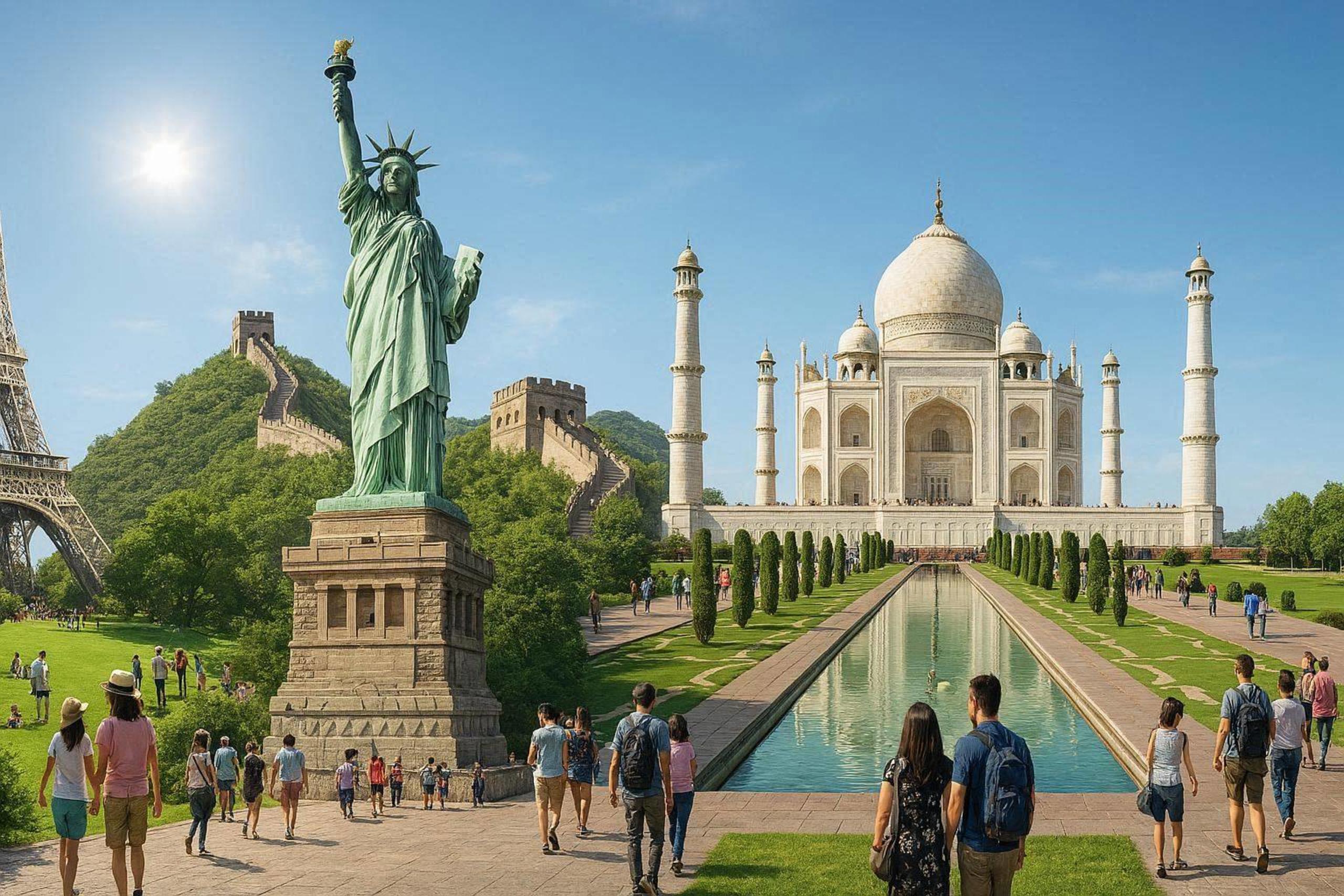
24. The Great Wall of China is not visible from space with the naked eye. This myth — still taught in some textbooks — has been definitively disproved by multiple astronauts including Chinese taikonauts. The Wall is simply too narrow (4-5 metres wide) to be resolved by the human eye from 400 km altitude, even though it is very long. What can be seen from low earth orbit are cities (their light pollution at night), large reservoirs, the Sahara Desert, and the Himalayan mountain range. The myth may have originated in a British almanac from 1932 — decades before anyone had actually been to space.
25. Venice has 400+ bridges and zero roads. Venice's historic centre (the main island) has no roads accessible by car — only canals and pedestrian footpaths. The city has 150+ canals, 400+ bridges, and 118 small islands connected by those bridges. Transportation within the city is by foot, gondola, vaporetto (water bus), or water taxi. Cars and motorbikes are parked on the mainland in Mestre or on the Tronchetto island car park and never enter the city. Venice is the only major city in the world without any road traffic — a fact that makes its evening atmosphere (after day-tripper crowds thin) unlike anywhere else on Earth.
🎒 Which of These Inspires Your Next Trip?• Finland's lake district in summer — sauna, silence, and a thousand shades of blue
• The Galapagos Islands — wildlife that looks you in the eye
• Iceland — a mosquito-free, midnight-sun-lit adventure
• Svalbard, Norway — live at 78 degrees North, no visa required
• Bhutan — the only country that puts happiness in its constitution ✈️ Inspired to Explore? Find Your Next Flight:
These facts are the beginning — the experiences are what you remember. Compare hundreds of airlines and book the best deal for wherever the world is calling you.
Search Flights Worldwide on Skyscanner → 🎟️ Book Unique Experiences Around the World:
From Galapagos wildlife tours to Bhutan trekking, Venice gondola rides to Iceland Northern Lights hunts — browse thousands of guided experiences and book in advance.
Browse Experiences Worldwide on GetYourGuide →
*Some links on this page are affiliate links. If you book through them, we may earn a small commission at no extra cost to you. This helps us keep the site free and the guides coming.