Bahrain is small enough to cross in under an hour, yet it holds more than 5,000 years of history. In three days you can walk a 4,000-year-old capital, see one of the largest prehistoric cemeteries on Earth, and follow the trail of the pearl merchants who made the island rich long before oil.
This itinerary keeps travel time short and puts the big sights at the best time of day: the souq in the cool of the morning, the mosque in the afternoon, and Bahrain Fort at sunset.
Before you book (checked 7 November 2026)
- The US State Department rates Bahrain Level 3: Reconsider Travel, citing terrorism and armed conflict (official advisory, updated 23 October 2026).
- The UK Foreign Office carries a regional tensions warning, saying the risk of sudden escalation in the Middle East is high (FCDO advice, updated 27 October 2026).
- Check your own government's advice and confirm your travel insurance still covers you before you book.
Bahrain in 3 Days at a Glance
| Day | Area | Highlights |
|---|---|---|
| Day 1 | Manama | Bab Al Bahrain, Manama Souq, Bahrain National Museum, Al Fateh Grand Mosque, Bahrain Bay at night |
| Day 2 | Ancient Bahrain | A'Ali Burial Mounds, Tree of Life, Bahrain Fort at sunset |
| Day 3 | Muharraq | The Pearling Path, Muharraq Souq, Arad Fort lit up at night |
Who this suits: first-time visitors, history lovers, food lovers and anyone on a long layover or a short Gulf break. If you have longer, our 7-day Bahrain itinerary adds the islands and beaches.
Day 1: Manama, Old and New
Morning: Bab Al Bahrain and Manama Souq
Start at Bab Al Bahrain, the gateway building that marks the entrance to the old market. Behind it, the lanes of Manama Souq sell spices, textiles, gold, perfume and sweets.
- Go early, before the midday heat.
- Stop for a cup of karak chai, the spiced milky tea sold at tiny stalls all over the souq.
- Walk deeper into the lanes for better prices. The shops right by the gateway charge more.
For what to eat as you wander, see our guide to the Manama Souq food experience.
Midday: Bahrain National Museum
Escape the heat at the Bahrain National Museum, the best place to understand the Dilmun civilisation before you see its sites tomorrow. Its halls cover burial customs, trade, pearling and traditional crafts.
Afternoon: Al Fateh Grand Mosque
Al Fateh Grand Mosque is one of the largest mosques in the world and one of the few in the Gulf with regular guided visits for non-Muslims.
- Dress modestly: shoulders and knees covered. Abayas and headscarves for women are usually available at the entrance.
- Visits pause for prayer times. Check opening hours before you go and avoid Friday midday prayers.
Evening: Bahrain Bay and the Skyline
End the day by the water. The towers of the Bahrain Financial Harbour and the wind turbines of the Bahrain World Trade Center light up after dark, and Bahrain Bay is pleasant for an evening walk.
For dinner, try machboos, Bahrain's national dish of spiced rice slow-cooked with fish, chicken or lamb.
Day 2: 5,000 Years of History
Morning: A'Ali Burial Mounds
Bahrain's Dilmun Burial Mounds became a UNESCO World Heritage Site in 2019. The mounds were built by the early Dilmun civilisation around 4,000 years ago, and the A'Ali Burial Mounds are among the most striking clusters, rising between modern houses.
Go in the morning, when the light is soft and the ground is cool.
Midday: The Tree of Life
Drive south into the desert to the Tree of Life, a mesquite tree around 400 years old that grows alone in the sand with no obvious water source. It's a short stop, but a memorable one.
Nearby, Jebel Al Dukhan is the island's highest point at about 134 metres. Access varies, so ask a local guide before planning a hike up Jebel Al Dukhan.
Tip: the south has little public transport and almost no shade. Hire a driver or rent a car for this half of the day, and carry water.
Late Afternoon and Sunset: Bahrain Fort
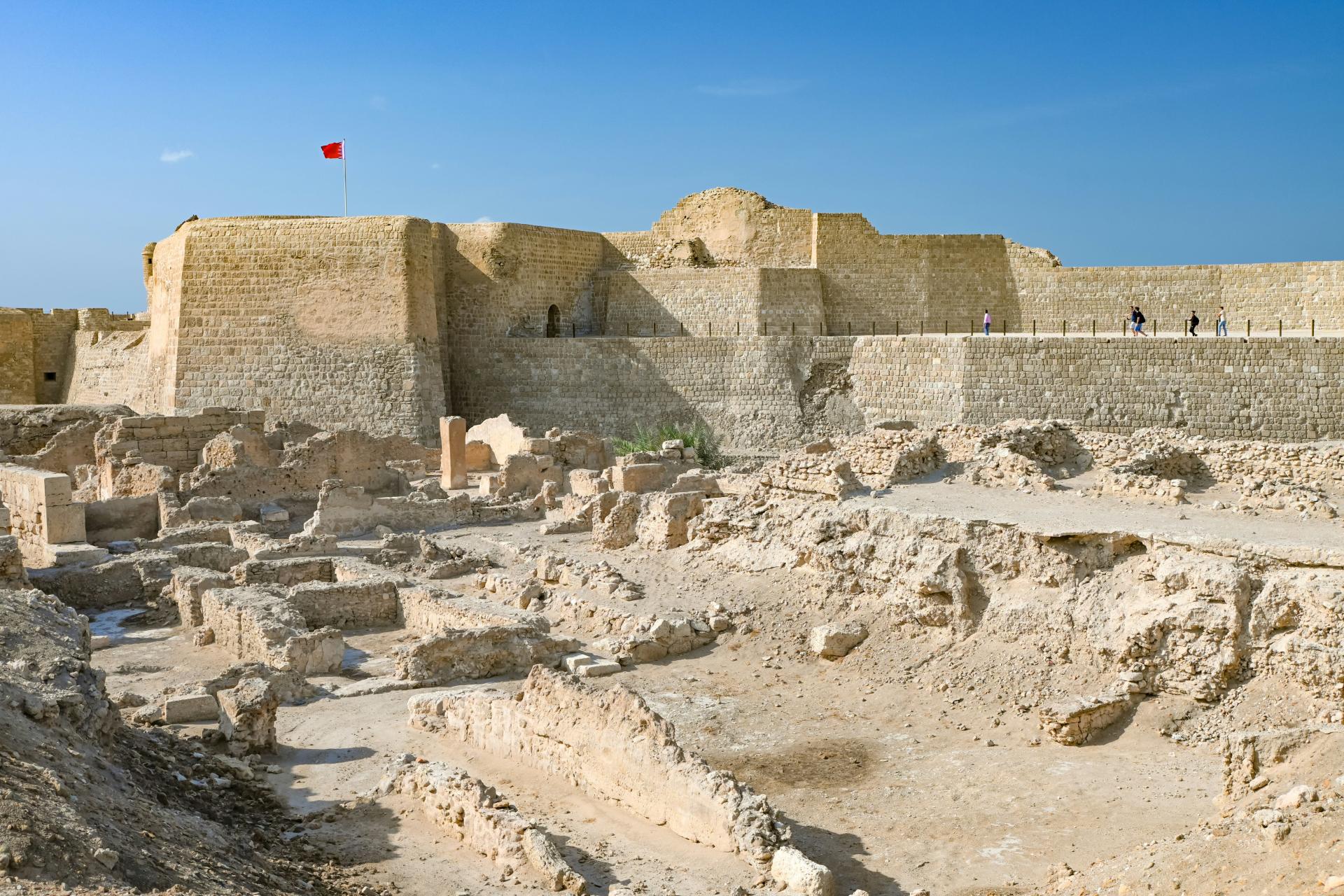
Bahrain Fort (Qal'at al-Bahrain) sits on a mound built up over thousands of years of settlement, occupied since at least 2300 BC. It was Bahrain's first UNESCO World Heritage Site, inscribed in 2005 as the ancient harbour and capital of Dilmun.
- Arrive an hour before sunset to explore the walls, then watch the sun go down over the sea.
- The site museum keeps shorter hours than the grounds, so visit it first.
Day 3: Muharraq and the Pearling Path
Morning: Walk the Pearling Path
Muharraq, Bahrain's former capital, is home to the Pearling Path, inscribed by UNESCO in 2012 as "Pearling, Testimony of an Island Economy". It links 17 restored buildings, including merchant houses and shops, along a walking route of about 3.5 km. The site also takes in three offshore oyster beds and the Qal'at Bu Mahir fort at the tip of the island.
Walk it in the morning and duck into the restored houses to see how pearl merchants, divers and boat builders lived. Our Muharraq guide has more on the old town.
Afternoon: Muharraq Souq and a Pearl Experience
Muharraq Souq is smaller and quieter than Manama's. Look for Bahraini halwa, a dense sweet flavoured with saffron and rose water.
If you'd like to go into the water yourself, book a guided pearl diving experience with a licensed operator. Trips depend on sea conditions and season.
Evening: Arad Fort
Finish at Arad Fort, a 15th-century fort on the Muharraq coast that's lit up beautifully at night. Pair it with grilled hammour, the Gulf grouper that is Bahrain's favourite fish.
Got a Fourth Day? Head for the Islands
- Al Dar Islands: a short boat ride for beaches, snorkelling and water sports.
- Jarada Island: a sandbar that appears at low tide, with turquoise water and white sand.
- Hawar Islands: quiet islands near Qatar, a Ramsar-listed wetland on Bahrain's UNESCO tentative list, known for birdlife such as flamingos and Socotra cormorants.
Browse more beaches in Bahrain and outdoor things to do in Bahrain.
Best Time to Visit Bahrain
| Months | Weather | Verdict |
|---|---|---|
| November–March | Mild, around 18–28°C | Best time. Ideal for walking the souqs and sites |
| October and April | Warm, rising heat | Good, with hot afternoons |
| May–September | Very hot, often 40°C+, humid | Hardest for sightseeing. Plan indoor days |
Events worth knowing:
- Spring of Culture: arts and music, February to April.
- Bahrain National Day: 16–17 December.
- Ramadan: quieter days, but lively evenings after sunset. Eating and drinking in public during daylight is not allowed.
- Formula 1: usually an early-season night race, but the 2026 race did not take place in Bahrain. Check the official F1 calendar before planning around it.
See the month-by-month picture on our best time to visit Bahrain page, and how dust storms affect plans in our Middle East sandstorm season guide.
How Much Do 3 Days in Bahrain Cost?
Bahrain is more affordable than Dubai or Doha. The Bahraini dinar (BHD) is pegged to the US dollar at about 1 BHD = 2.66 USD, so prices can look low on paper and still add up fast.
| Style | Per day | About |
|---|---|---|
| Budget | BHD 25–40 | USD 65–105 |
| Mid-range | BHD 60–100 | USD 160–265 |
A mid-range 3-day trip comes to about USD 400 per person, not counting flights. That covers a shared double room, food, local transport and sights. Plug in your own dates, group size and hotel style with our Bahrain budget calculator.
Money tips:
- Cards are widely accepted. Use bank ATMs or licensed exchange bureaux, never street money changers.
- Many historic sites are free or cheap. Your biggest costs will be hotels and taxis.
Getting Around Bahrain
| Option | Best for | Good to know |
|---|---|---|
| Ride-hailing (Uber, Careem) | Most trips | Fixed upfront prices, cashless |
| Taxis | Airport, hotels, malls | Agree the fare or insist on the meter |
| Buses | Budget trips in and around Manama | Run by Bahrain Public Transport. Pay with a rechargeable Go Card. Coverage of tourist sites is patchy |
| Rental car | Day 2 in the south | Drive on the right. Check whether you need an International Driving Permit |
There is no metro or train. Bahrain International Airport (BAH) is in Muharraq, a short drive from Manama.
For a multi-country trip, the King Fahd Causeway links Bahrain to Saudi Arabia by road. Qatar, the United Arab Emirates and Oman are short flights away.
Visa and Entry
Many nationalities, including visitors from the US, UK, EU, Canada and Australia, can get a visa on arrival or apply online for an eVisa through the official portal at evisa.gov.bh. Stays of up to 14 days are typical. Citizens of Gulf (GCC) countries don't need a visa.
Rules change, so check your passport with our Bahrain visa checker and confirm on the official portal before you fly.
Staying Connected: SIM Cards and eSIMs
Bahrain's mobile networks are Batelco, stc Bahrain and Zain. You can buy a tourist SIM at the airport, or set up a travel eSIM before you land so you have maps and ride-hailing from the moment you arrive. Compare eSIM options on our Bahrain travel guide.
Plugs: Type G (the three-pin UK style), 230 V.
Safety Advice
Read the official advisories at the top of this guide first. They reflect regional tensions in 2026 and can change quickly.
Day to day, petty crime against tourists is uncommon, but take normal precautions:
- Emergency number: 999 for police, ambulance and fire.
- Scams: taxis without meters, fake "natural pearls" at bargain prices, and souvenir shops by Bab Al Bahrain.
- Pickpockets: busy souq lanes on weekend evenings.
- Weekend: Bahrain's weekend is Friday and Saturday, when souqs and malls are busiest.
- Alcohol: legal in licensed hotels and venues, but never in public.
- Dress: cover shoulders and knees at mosques, souqs and traditional neighbourhoods.
See the full Bahrain safety guide, and open Trip Mode on your phone for emergency numbers, currency and weather that work offline.
Insider Tips
- Do the south by car. One half-day rental or driver covers the mounds, the Tree of Life and Bahrain Fort far faster than buses.
- Time Bahrain Fort for sunset. It's the best light of the trip and the site is at its calmest.
- Eat where the queues are. Small souq cafés serve the best karak chai and samboosa for very little.
- Plan around Friday. Mosques pause for midday prayers, while souqs and beaches fill up in the afternoon.
- Pack for sun, not cold. Even in winter the midday sun is strong. Our packing list builder creates a checklist for a city and beach trip.
Frequently Asked Questions
Is 3 days enough for Bahrain?
Yes. Three days covers Bahrain's main sights: Manama's souq and mosque, the ancient Dilmun sites and Bahrain Fort, and Muharraq's Pearling Path. Add a fourth day for the islands, or see our 7-day itinerary.
What is the best month to visit Bahrain?
November to March is best, with daytime temperatures around 18–28°C. October and April are warm but still good. Summer, May to September, is often above 40°C and humid.
How much does a 3-day trip to Bahrain cost?
About USD 400 per person for a mid-range trip, excluding flights. Budget travellers can manage on roughly BHD 25–40 (USD 65–105) a day. Hotels and taxis are the biggest costs.
Do I need a visa for Bahrain?
Many nationalities can get a visa on arrival or an eVisa from evisa.gov.bh, usually for stays of up to 14 days. GCC citizens don't need one. Check your passport with our visa checker before you travel.
Is Bahrain safe to visit right now?
As of November 2026, the US rates Bahrain Level 3, "Reconsider Travel", and the UK warns of regional tensions. Day-to-day crime against tourists is low, but check your government's latest advice and your insurance before booking.
What are Bahrain's UNESCO World Heritage Sites?
Bahrain has three: Qal'at al-Bahrain (Bahrain Fort), inscribed in 2005; the Pearling Path in Muharraq, inscribed in 2012; and the Dilmun Burial Mounds, inscribed in 2019.
Conclusion: Small Island, Deep History
In just three days, Bahrain takes you from Dilmun's ancient harbour to the pearl merchants' houses of Muharraq and the glass towers of Manama. It's compact, easy to get around and full of history most travellers don't expect.
Start planning with our 3-day Bahrain itinerary planner, which lets you change the pace and length, or explore everything in our Bahrain travel guide. For more ideas, browse all our itineraries.
How we built this itinerary: the places, food and costs come from PickNGoTravel's Bahrain guide and budget calculator. UNESCO status, entry rules and travel advice were checked against UNESCO, the Bahrain eVisa portal, the US State Department and the UK Foreign Office on 7 November 2026. Prices are estimates and change. Spotted something out of date? Tell us.