
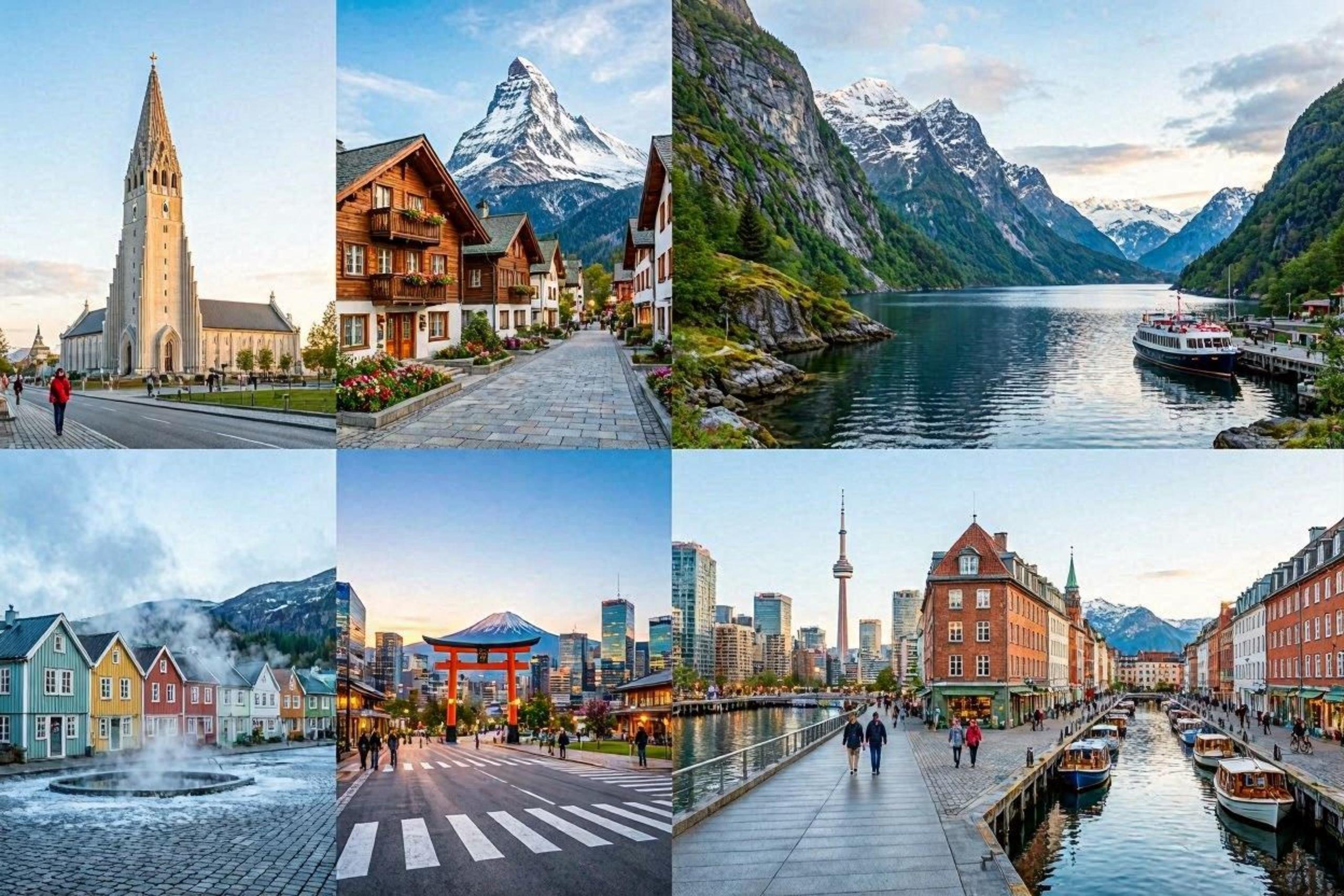
Choosing a safe destination is the first step toward a stress-free trip. Whether you are a solo female traveler, a family with young children, or a first-time international traveler, safety shapes the entire experience. This guide ranks the 10 safest countries to visit in 2026-2027 based on the Global Peace Index, crime statistics, healthcare quality, and real traveler feedback.
Good news: safety and great travel experiences go hand in hand. These countries are not just safe — they are also stunning, culturally rich, and incredibly well set up for tourists.
🛡️ Quick Safety Facts• Rankings based on the 2025 Global Peace Index (GPI) by the Institute for Economics and Peace
• All 10 countries score in the top 15% globally for safety and security
• Each country has strong healthcare infrastructure accessible to tourists
• Travel insurance is still recommended regardless of destination safety rating 🌍 Protect Your Trip with Travel Insurance:
Even the safest countries can have unexpected medical emergencies, cancellations, or lost luggage. Compare policies and get covered before you fly.
Get Affordable Nomad Travel Insurance with SafetyWing →
Compare Comprehensive Policies on World Nomads →
1. Iceland — The World's Most Peaceful Country
Iceland has held the top spot on the Global Peace Index for 16 consecutive years — an achievement no other country comes close to matching. With a population of just 370,000, Iceland has virtually no organized crime, almost no violent crime, and a deeply ingrained culture of trust and cooperation. Locals regularly leave car doors unlocked and babies sleeping in prams outside cafes without a second thought.
Travelers benefit from this peace culture directly. You can hike alone at midnight under the midnight sun, drive the Ring Road solo, and camp in remote areas without safety concerns. The police carry no firearms. Emergency services respond fast even in rural areas, and the entire island has reliable 4G coverage including most highland tracks.
Healthcare in Iceland is universal and high-quality, with Landspitali Hospital in Reykjavik handling emergencies around the clock. Pharmacies are well-stocked and staff typically speak fluent English. The biggest real hazards in Iceland are natural — geothermal activity, sudden weather changes, and volcanic fissures — all of which are well-signposted and monitored in real time on the safetravel.is platform.
Best for: Solo female travelers, couples, digital nomads, nature enthusiasts. Safety score (GPI 2025): 1.107. Currency: ISK. Language: Icelandic (English universally spoken).
2. Japan — Safest Major Economy in the World
Japan is the safest large country in the world, combining a massive population of 125 million with crime rates that rival small Nordic nations. Japan ranks #2 on the Global Peace Index and has the lowest homicide rate of any G7 country. Petty crime is extremely rare — lost wallets are routinely handed in to police stations, often with cash still inside.
The country's safety culture runs deep. Train platforms have barriers, crossings have audio cues, and even earthquake evacuation procedures are practiced regularly in schools and offices. Japan's disaster preparedness — for earthquakes, tsunamis, and typhoons — is among the most advanced in the world, with public alert systems, multilingual emergency broadcasts, and a dense network of evacuation shelters.
As a traveler, you will feel the difference immediately. Walking alone at 2 AM through Shinjuku or Osaka feels completely normal. Convenience stores are open 24/7 and serve as informal community safety anchors in neighborhoods across the country. Staff at ryokans, hotels, and tourist offices go out of their way to help foreign visitors navigate safely.
Best for: Solo travelers, solo female travelers, families with children, first-time Asia visitors. Safety score (GPI 2025): 1.336. Currency: JPY. Best time to visit: March-May (cherry blossom) or October-November (autumn foliage).
3. Switzerland — Safest Country in Central Europe
Switzerland ranks among the top 5 safest countries globally, with some of the lowest crime rates in Europe. Geneva, Zurich, and Basel consistently appear on lists of the world's most liveable and safest cities. Political neutrality (maintained since 1815), strong institutions, and a highly educated population contribute to Switzerland's exceptional stability.
Healthcare in Switzerland is world-class. The country spends more on healthcare per capita than almost any other nation, and hospitals in major cities are equipped to handle everything from altitude sickness to complex surgery. EU visitors benefit from reciprocal health agreements; non-EU travelers should carry comprehensive travel insurance.
The Swiss transport network — trains, PostBuses, and ferries — is legendary for punctuality and safety, making it very easy to navigate the country independently. Mountain regions have excellent trail marking, avalanche monitoring systems, and mountain rescue services that can reach most areas by helicopter within minutes.
Best for: Families, couples, luxury travelers, outdoor adventurers. Safety score (GPI 2025): 1.339. Currency: CHF. Note: Switzerland is expensive — budget CHF 150-300/day for mid-range travel.
4. New Zealand — Safest Country in the Pacific
New Zealand consistently ranks in the global top 5 for safety and is widely considered the safest destination in the Asia-Pacific region. The country has low crime, a transparent government, and a culture of openness that makes international travelers feel genuinely welcomed rather than merely tolerated.
For outdoor adventurers, New Zealand is a dream — but safety infrastructure matches the ambition. DoC (Department of Conservation) huts on Great Walks are well-maintained and staffed; trails are graded and marked; locator beacons can be hired from visitor centers. The national emergency number (111) covers police, fire, and ambulance, and helicopters can reach most remote areas within an hour.
Cities like Auckland, Wellington, and Christchurch are safe and easy to navigate. Public transport is reliable, Uber and rideshares operate in major centers, and the local population is famously friendly. The Maori concept of manaakitanga — care and hospitality toward guests — underpins the entire tourism culture.
Best for: Adventure travelers, families, solo female travelers, backpackers. Safety score (GPI 2025): 1.312. Currency: NZD. Best time to visit: December-February (summer) for outdoor activities.
5. Ireland — Friendliest Safe Country in Western Europe
Ireland ranks in the global top 10 for safety and regularly wins awards as one of Europe's most welcoming destinations for international visitors. Violent crime is rare outside of a few urban areas late at night, and tourist-focused areas across Dublin, Galway, and County Kerry are exceptionally safe at all hours.
The Irish healthcare system — while under pressure domestically — provides emergency care to all visitors. Private hospitals like the Mater Private and Beacon Hospital offer fast access to specialist care. English as the primary language removes a major barrier for travelers dealing with health or safety situations.
Ireland's rural areas are arguably safer than its cities, and the Wild Atlantic Way — one of the world's great coastal drives — passes through communities where crime is virtually nonexistent. Locals are genuinely helpful and will go out of their way to assist a lost traveler. Pub culture is social and inclusive, making solo travel particularly rewarding.
Best for: Solo travelers, culture seekers, English-speaking first-time solo travelers. Safety score (GPI 2025): 1.294. Currency: Euro (EUR). Best time to visit: May-September for the mildest weather.
6. Austria — Safest Country for City Breaks
Austria ranks consistently in the global top 5 safest countries and Vienna has topped the Mercer Quality of Living Survey for cities multiple years in a row. The capital is especially notable — its metro system runs 24 hours on weekends, streets are clean and well-lit, and the historic centre is extremely safe even late at night.
Austrian healthcare is universal and among Europe's best. EU citizens access it with a European Health Insurance Card; non-EU visitors should carry travel insurance. Pharmacies are frequent and well-stocked, and many staff speak English in tourist areas. Mountain regions in Tyrol and Salzburg have professional ski patrol and mountain rescue services operating year-round.
Beyond Vienna, cities like Salzburg, Innsbruck, and Graz are compact, walkable, and extremely safe. The Austrian rail network (OBB) is efficient, punctual, and runs to the smallest alpine villages. Hiking trails in the Alps are graded and marked to a very high standard, with refuges (Hutten) providing shelter and emergency communication.
Best for: City travelers, families, classical music enthusiasts, alpine hikers. Safety score (GPI 2025): 1.279. Currency: Euro (EUR). Tip: Vienna Card gives unlimited public transport plus museum discounts.
7. Singapore — Safest City-State in Southeast Asia
Singapore has one of the lowest crime rates in the world for an urban area of its size (6 million people). Strict laws, heavy policing, and an exceptionally high standard of living contribute to a society where violent crime is vanishingly rare. The city-state ranked #5 globally on the 2025 Global Peace Index — remarkable for a dense, cosmopolitan urban center.
The healthcare system in Singapore is world-class and operates efficiently for visitors through private hospitals like Mount Elizabeth, Gleneagles, and Raffles Hospital — all English-speaking, all equipped to handle complex cases. Medication is widely available over the counter for minor ailments. Mosquito-borne illnesses (dengue) are a real but manageable risk — use repellent and check government health advisories.
Navigation in Singapore is effortless: the MRT metro system covers the entire island, taxis and Grab (rideshare) are safe and metered, and English is one of four official languages. The city is intensely tourist-friendly — information centers, clear signage, and helpful locals make it one of the easiest cities in Asia to navigate alone.
Best for: Solo travelers, first-time Asia visitors, families, business travelers. Safety score (GPI 2025): 1.339. Currency: SGD. Note: Strict laws — do not chew gum in public, respect drug laws (penalties are severe).
8. Denmark — Happiest and One of the Safest Countries in Europe
Denmark ranks in the global top 10 for safety and consistently tops the World Happiness Report. Copenhagen is frequently voted the world's most liveable city, combining world-class cycling infrastructure, public safety, and social trust. Crime rates are low by European standards, and tourist areas are safe day and night.
The Danish healthcare system is universal and highly efficient. Tourists from EU countries access emergency care with a European Health Insurance Card; all other visitors receive emergency treatment and are billed afterward (travel insurance is essential). Pharmacies — called apoteket — are well-stocked and staff speak excellent English.
Getting around Denmark is a pleasure: Copenhagen's metro runs 24/7, bikes are available to rent on every corner, and the country is compact enough to day-trip to the countryside from the capital. The Danish design philosophy of clear, intuitive public spaces extends to wayfinding — getting lost in Denmark is genuinely difficult.
Best for: Families, design lovers, cyclists, sustainable travelers. Safety score (GPI 2025): 1.316. Currency: DKK. Tip: Copenhagen Cards give free public transport and museum access — worth it for 2+ days.
9. Portugal — Safest Budget-Friendly Country in Western Europe
Portugal ranks #7 globally on the 2025 Global Peace Index and offers something rare among safe countries: genuine affordability. Lisbon and Porto have boomed as tourist destinations over the past decade, yet crime levels remain low by European standards. Petty theft exists in crowded areas (common to all tourist cities), but violent crime is very rare.
The National Health Service (SNS) provides emergency care to all visitors regardless of origin. English is widely spoken in cities and tourist areas, and pharmacists can advise on minor ailments — many medications available only by prescription elsewhere are sold over the counter in Portugal. Rural areas have fewer English speakers but are exceptionally safe.
Portugal is particularly popular with solo female travelers, digital nomads, and retirees — groups who consistently rate it as one of the most welcoming and hassle-free destinations in Europe. Algarve beach towns, the Douro Valley wine country, and historic Sintra are all easily navigated independently, with reliable local buses and affordable taxis.
Best for: Budget travelers, solo female travelers, digital nomads, retirees, families. Safety score (GPI 2025): 1.238. Currency: Euro (EUR). Best time to visit: May-June or September-October (good weather, fewer crowds).
10. Canada — Safest Country in North America
Canada ranks #11 globally on the 2025 Global Peace Index, making it by far the safest country in North America and one of the safest in the world for its geographic scale. Cities like Vancouver, Toronto, Montreal, and Quebec City are welcoming to international visitors, with diverse populations, strong multicultural policies, and low rates of violent crime in tourist areas.
The Canadian healthcare system covers citizens and permanent residents, but tourists must pay for medical care — travel insurance is non-negotiable here. Private health costs are high: an emergency room visit can run CAD 1,000-5,000 without coverage. SafetyWing and World Nomads both offer affordable plans for Canada visits.
Canada's national parks (Banff, Jasper, Algonquin) are well-maintained with clear trail systems, ranger patrols, and wildlife safety briefings. Bear encounters are managed through education and bear canister requirements. Urban areas are safe and navigable by public transit; Uber and rideshares operate in all major cities. French-speaking Quebec has its own cultural character but is just as safe and welcoming to English speakers.
Best for: Nature lovers, families, outdoor adventurers, wildlife enthusiasts. Safety score (GPI 2025): 1.465. Currency: CAD. Note: Distances are vast — internal flights or long drives are often necessary between regions.
Practical Safety Tips for Every Destination
Even the safest countries require basic travel sense. These habits apply everywhere:
- Purchase comprehensive travel insurance before departure — covering medical emergencies, trip cancellation, and baggage loss
- Register your trip with your home country's embassy or consular service (most have free online registration systems)
- Store digital copies of passport, visa, travel insurance, and hotel bookings in a secure cloud location
- Share your itinerary with someone at home, especially for remote or wilderness travel
- Research local emergency numbers — 112 works across the EU; other countries vary
- Follow local laws and cultural norms — drug laws, photography restrictions, and dress codes vary significantly
- Use ATMs inside banks rather than standalone street machines; notify your bank before traveling
- Trust your instincts — even in safe countries, avoid poorly lit isolated areas late at night
Medical emergencies abroad can cost tens of thousands of dollars without coverage. SafetyWing starts from as low as $42/4 weeks for digital nomads and short-term travelers — one of the most affordable options available.
Get SafetyWing Nomad Insurance (from $42/month) →
Compare Plans on World Nomads →
