Portuguese food is one of Europe's most underrated culinary traditions — built on the Atlantic Ocean, centuries of spice trade routes, and an ingredient-first philosophy that predates farm-to-table by 500 years. Lisbon is now one of Europe's top food capitals. Porto has a growing fine-dining scene built on humble classics. The Alentejo produces some of the continent's finest olive oil, pork, and wine. And the Algarve grills the freshest seafood on the Iberian Peninsula.
This guide covers everything you need to eat and drink well in Portugal — the essential dishes by region, where to eat the best version of each, what to pay, and the drinks that complete every meal.
🍽️ Portugal Food Quick Facts• Currency: Euro (€) — budget meals from €4–8
• Meal times: Lunch 12:30–3pm | Dinner 7:30–10:30pm
• Tipping: Not mandatory — round up or leave €1–2 at sit-down restaurants
• National dish: Bacalhau (salt cod) — over 365 recipes, one for every day of the year
• Best food cities: Lisbon, Porto, Évora, Tavira
1. Bacalhau — Portugal's National Dish
No dish defines Portugal more than bacalhau (dried, salted codfish). The Portuguese have been drying and salting cod since the 15th century, when fishing fleets ventured to the Grand Banks of Newfoundland. The result is a preserved ingredient with an intense, savoury depth that fresh cod simply cannot replicate. Soaked overnight in cold water to rehydrate, bacalhau takes on hundreds of forms — the Portuguese claim a different recipe for every day of the year.
The most celebrated preparations:
- Bacalhau à Brás — shredded cod scrambled with eggs, thin-cut chips, and black olives. The most approachable entry point.
- Bacalhau com Natas — cod baked in a cream and potato gratin. Rich, satisfying, cold-weather comfort food.
- Bacalhau à Gomes de Sá — flaked cod baked with potatoes, onion, hard-boiled eggs, and olives. The Porto classic.
- Bacalhau Assado — a thick fillet simply roasted with olive oil, garlic, and potatoes. The purist's version.
Where to eat: Solar dos Presuntos (Lisbon) for bacalhau à Brás; Taberna do Largo (Lisbon) for creative bacalhau interpretations; Adega de São Nicolau (Porto) for Gomes de Sá in its hometown.
Price range: €10–16 at a tasca (traditional tavern) | €18–28 at a mid-range restaurant.
Pro tip: Ask locals which tasca they go to for bacalhau — not which restaurant. The best versions in Portugal are often in unmarked rooms with plastic tables and handwritten daily menus.2. Pastéis de Nata — The Custard Tart That Conquered the World
Pastel de nata (plural: pastéis de nata) is Portugal's most iconic export — a flaky, laminated pastry shell filled with a slightly caramelised egg custard cream, dusted with cinnamon and powdered sugar. The original recipe was developed by monks at Mosteiro dos Jerónimos in Belém, Lisbon, sometime before 1837. The pastry at the adjacent Pastéis de Belém bakery still uses the original recipe, kept secret to this day. They sell roughly 20,000 per day.
The difference between a good one and a great one: the pastry must be properly laminated (visible layers, shatteringly crisp), the custard must be slightly scorched on top from a very hot oven (around 300°C), and it must be eaten warm — within 20 minutes of leaving the oven.
Where to eat: Pastéis de Belém (Lisbon, the original, always a queue); Manteigaria (Lisbon, Time Out Market and Chiado — shorter queue, equally excellent); Padaria Ribeiro (Porto) for the northern interpretation.
Price: €1.30–€1.60 each everywhere in Portugal. Cheaper than anywhere else in the world.
🍰 Lisbon Food Tours — Taste Pastéis de Nata Like a Local:Skip the tourist spots and discover where Lisbon's chefs actually eat — guided food walks through Alfama, Mouraria, and the Mercado da Ribeira.
Browse Lisbon Food Tours on GetYourGuide →
3. Francesinha — Porto's Legendary Sandwich
The Francesinha is Porto's contribution to the pantheon of great European sandwiches — and it is unlike any other. Layers of cured ham, linguiça sausage, and steak are sandwiched between thick toast, blanketed in melted cheese, then drowned in a spiced tomato and beer sauce. A fried egg sits on top. It is extraordinary and aggressively filling — one is a full meal for most people.
The sauce is the defining element and every Francesinha restaurant guards theirs fiercely. The recipe typically involves tomato, beer (usually Super Bock), brandy or whisky, chilli, bay leaf, and various secret additions. Served with chips cooked in the same sauce.
Where to eat: Café Santiago (Porto, the most legendary, always a queue); A Regaleira (Porto, locals' favourite since 1933); Lado B (Porto) for a modern, lighter interpretation.
Price range: €10–15 including chips and a beer.
4. Grilled Sardines — The Taste of a Portuguese Summer
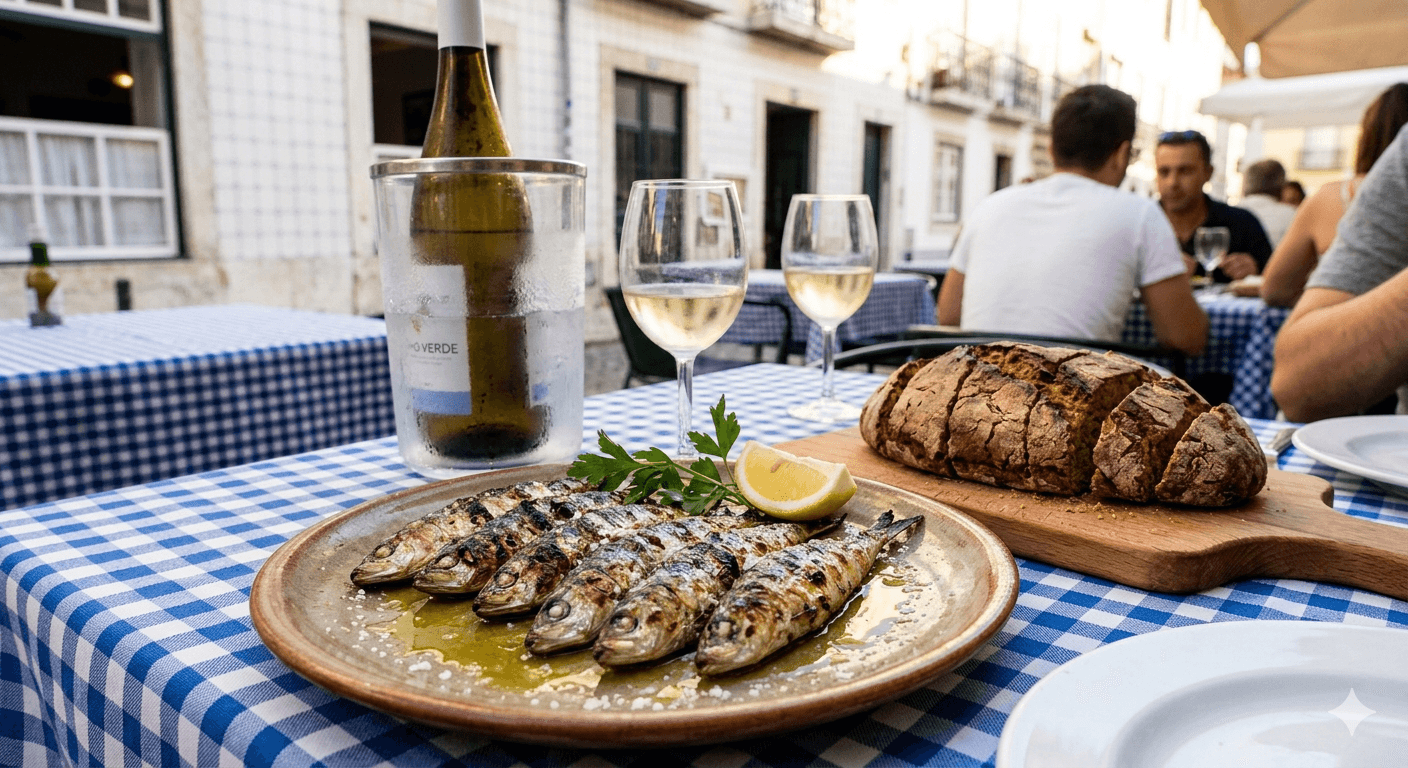
Every June, Lisbon celebrates the festas dos Santos Populares — neighbourhood festivals where the entire city fills with the smell of sardinhas assadas (charcoal-grilled sardines) served on thick slices of bread. But grilled sardines are available everywhere in Portugal from May to October. The sardine must be fresh, fat with summer oil, and cooked whole over charcoal until the skin blisters.
The correct way to eat them: with boiled potatoes, roasted peppers, a glass of Vinho Verde, and your hands. No cutlery, no ceremony. Sardines are sold by unit or by weight — a typical portion is 4–6 fish.
Where to eat: Cervejaria Ramiro (Lisbon, the city's finest seafood institution); O Marisco (Cascais) for freshly grilled on a harbour-side terrace; any festival or tasca in Alfama during June.
Price range: €8–14 per portion at a restaurant | €2–3 per sardine at a festival stall.
5. Caldo Verde — Portugal's Comfort Soup
Caldo Verde literally translates as "green broth" — a hearty soup of finely shredded couve-galega (a dark, slightly bitter Galician kale unique to the Minho region of northern Portugal), potato, onion, garlic, and a round of chouriço (smoked paprika sausage). Simple, nourishing, and warming. It is the soup every Portuguese grandmother makes, and the soup every restaurant serves as a starter for €3–5.
Caldo Verde originated in the Minho region but is now the unofficial national soup. It appears at everything from weddings to football post-game meals. Drink it with broa (cornbread) and it becomes a meal in itself.
Where to eat: Any tasca or traditional restaurant in Portugal — this is not a speciality dish, it is background infrastructure. Every kitchen makes it.
Price range: €3–6 as a starter.
6. Bifanas — The Portuguese Pork Sandwich
The bifana is Portugal's answer to the banh mi, the torta, and the cheesesteak — and it is exceptional. Thin slices of pork loin are marinated in white wine, garlic, paprika, and bay leaf, then quickly sautéed and stuffed into a crusty papo-seco roll. The bread soaks up the pan juices. Add mustard, piri piri sauce, or both.
Bifanas are sold at tascas, petiscos bars, and street stalls, and are one of Portugal's great cheap eats. The version at O Zé da Bifana in Lisbon's Baixa has been feeding the city for decades. The version at Évora's market is widely considered among the country's finest.
Price range: €2.50–4 at a tasca or street stall.
Budget tip: A bifana and a Super Bock beer at a stand-up counter will cost you €4–5 total. It is one of the best value meals in Western Europe.7. Percebes — Portugal's Most Expensive Delicacy
Percebes (goose barnacles) are harvested from Atlantic wave-battered rocks along Portugal's coastline — particularly in the Algarve and the Costa Vicentina. Harvesters risk their lives working the cliff edges when waves recede, giving percebes their extraordinary price. They look prehistoric (like small dinosaur claws) and taste intensely of the sea — clean, briny, mineral, unlike anything else.
To eat: twist and pull the leathery skin off the stem, then eat the soft, flavourful flesh inside. Serve simply: boiled in salted seawater, with lemon. Nothing else needed.
Where to eat: Cervejaria Ramiro (Lisbon); any restaurant on the Algarve coast near Sagres or Aljezur; seafood markets in Peniche or Cascais.
Price range: €25–50 per 100g — a small plate to share costs €30–60. Order sparingly; they are a luxury experience, not a meal.
8. Piri Piri Chicken
Frango piri piri is Portugal's most exported dish — spatchcocked chicken marinated in piri piri chilli paste (made from African bird's eye chilli, garlic, lemon, and olive oil), then charcoal-grilled and basted repeatedly until the skin is lacquered, charred, and fiercely spiced. The marinade penetrates the meat; the charcoal gives it an irreplaceable smokiness. The recipe came from Mozambique and Angola during the colonial era and became naturalised into Portuguese cuisine over the 20th century.
Served with chips, salad, and plenty of napkins. Eat it with your hands.
Where to eat: Churrasqueira do Rego (Lisbon) for a packed local institution; any churrascaria (grill restaurant) in the Algarve; the roadside grill stalls between Albufeira and Lagos for the most smoky, charcoal-heavy versions.
Price range: €8–14 for a half chicken with chips and salad.
🍷 Porto Wine & Food Tours — The Douro Valley & Ribeira:Combine Port wine tastings in Vila Nova de Gaia with a Francesinha, petiscos, and a local guide who knows where the Porto food scene actually eats.
Browse Porto Food & Wine Tours on GetYourGuide →
What to Drink in Portugal
Vinho Verde
Vinho Verde ("green wine") is not named for its colour — the white version is the most common — but for the young, fresh grapes harvested early in the Minho region. It is light (9–11% ABV), slightly effervescent, crisp, and low in alcohol. It is the perfect warm-weather wine, the ideal companion for sardines, seafood, and bifanas. A bottle at a restaurant costs €8–14; a glass costs €2–4. Inexpensive and delicious.
Port Wine
Vinho do Porto is Portugal's most internationally famous wine — a fortified wine produced exclusively in the Douro Valley, aged in wooden barrels in Vila Nova de Gaia (across the river from Porto). Ruby Port is fruity and full-bodied; Tawny Port is nutty and oxidative, aged longer in smaller barrels. White Port, served chilled with tonic water and a slice of lemon, is the local apéritif in Porto. A tasting flight at a Port lodge costs €5–20 depending on the wines selected.
Where to taste: Graham's, Sandeman, or Ramos Pinto lodges in Vila Nova de Gaia — all offer tours and tastings.
Alentejo Reds
The sun-baked Alentejo region produces Portugal's most full-bodied red wines — powerful, fruit-forward, often with a touch of spice from indigenous grape varieties like Aragonez (Tempranillo) and Alicante Bouschet. Look for estates like Esporão, Herdade do Mouchão, and Monte da Casteleja. A good Alentejo red at a restaurant costs €14–22 a bottle.
Ginjinha
Ginjinha is a sour cherry liqueur that has been made in Lisbon since 1840. Served in tiny glasses or in a small chocolate cup, it is drunk as a quick shot in doorway bars around Rossio Square. The most famous is A Ginjinha on Largo de São Domingos — a one-room, one-product bar that has been doing exactly this since the 19th century. A shot costs €1.40–€1.80. It is mandatory in Lisbon.
Super Bock & Sagres
Portugal's two national lagers divide the country geographically — Super Bock in Porto and the north, Sagres in Lisbon and the south. Both are clean, cold, and refreshing. A 0.33L bottle at a tasca costs €1.20–€1.80. On tap (imperial — a small draught) costs €1–€1.50.
🍇 Douro Valley Wine Tours — Day Trips from Porto:The Douro Valley is one of the world's most spectacular wine regions. Wine tastings at quintas (estates), river cruises, and olive oil pressing — book ahead in summer.
Browse Douro Valley Day Trips on Viator →
Best Food Markets in Portugal
- Time Out Market (Mercado da Ribeira), Lisbon — The landmark covered market in Cais do Sodré with 40+ vendors curated by Time Out. Held by critics but excellent for tasting multiple cuisines quickly. €8–16 per dish.
- Mercado de Campo de Ourique, Lisbon — The neighbourhood market where Lisboetas actually shop. Ground floor is a fresh food market; upstairs is a food hall. Cheaper and more local than Ribeira.
- Mercado do Bolhão, Porto — Reopened in 2022 after restoration. The spiritual centre of Porto food culture: fresh fish, cured meats, fruit, cheese, and the best tosta mista (grilled ham and cheese) in the city.
- Mercado de Loulé, Algarve — A Moorish-style indoor market with the finest regional produce in the Algarve: local honey, Medronho (arbutus berry brandy), fresh fish, and handmade cheeses.
Portuguese Food: Rules Worth Knowing
- The bread and starters are not free — Restaurants routinely bring bread, olives, cheese, and chouriço to the table without asking. You will be charged for what you eat. Push it back if you don't want to pay (€1–4 per item).
- Lunch is the best value meal — A prato do dia (daily special) at a tasca costs €7–11 and includes a main course, a drink, and often bread and soup. Far better value than dinner.
- Tascas beat restaurants for authenticity — The best Portuguese food is in tascas with handwritten daily menus, plastic tablecloths, and no English menu. The tourist-facing restaurants near major monuments are almost universally inferior.
- Petiscos are Portugal's tapas — Small shared plates of bacalhau cakes, chouriço, alheira sausage, and presunto ham. Order several at a petiscos bar and graze through dinner. Cheaper and more fun than a three-course meal.
- Coffee is taken seriously — A Portuguese bica (espresso) costs €0.80–€1.20 at the bar and is consistently excellent. A galão (similar to a latte) costs €1.30–€1.80. Never order a cappuccino after 11am.
Lisbon (LIS) and Porto (OPO) are both well-connected to Europe and North America. Compare prices across hundreds of airlines and lock in your dates.
Search Flights to Portugal on Skyscanner →
*Some links in this guide are affiliate links. If you book through them, we may earn a small commission at no extra cost to you. This helps us keep the guides free.