Your passport is one of the most powerful — or most limiting — documents you will ever carry. For some people, it unlocks 193 countries visa-free. For others, it restricts access to fewer than 30. The difference is entirely determined by the nationality printed on its cover — a fact of birth, not merit, talent, or wealth. Passport power is one of travel's most fascinating, and most unequal, realities. These 30 verified facts pull back the curtain on how passports work, which ones dominate, and the strange, sometimes absurd, rules governing how the world's borders actually operate.
Whether you are trying to understand your own travel options or simply fascinated by the global mobility gap, this is everything the official documents never tell you.
🛂 How Powerful Is Your Passport? — A Quick Scale• Tier 1 (185–195 destinations): Japan, Singapore, Germany, France, Italy, Spain, Finland, South Korea
• Tier 2 (160–184 destinations): USA, Canada, Australia, New Zealand, UAE
• Tier 3 (100–159 destinations): Brazil, Mexico, South Africa, Turkey, China, India
• Tier 4 (Under 100 destinations): Pakistan, Iraq, Somalia, Afghanistan, North Korea
→ Check your exact visa-free count with our free Visa Checker
🏆 The World's Strongest Passports
1. Japan has held the world's most powerful passport since 2018 — almost continuously. As of 2025, the Japanese passport provides visa-free or visa-on-arrival access to 193 destinations — the highest of any country. Japan achieved this through decades of diplomatic relationship-building, consistent compliance with international migration norms, and a historically low overstay rate. Notably, Japan is one of the rare countries where passport strength exceeds the nation's own tourism reception: Japan is the third most visited country in Asia yet issues one of the most restrictive immigration policies in the developed world.
2. Singapore's passport was ranked the least powerful in Asia as recently as 1967 — and is now second in the world. At independence in 1965, Singapore was a tiny city-state of 1.8 million people with almost no international diplomatic relationships. Through strategic foreign policy, zero international conflicts, and positioning itself as a neutral financial and logistics hub, Singapore built the visa-free relationships that now give its passport access to 192 destinations. The transformation from weakest to nearly strongest in under 60 years has no parallel in passport history.
3. Germany, France, Italy, Spain, Finland and South Korea all share second or third place in passport rankings — with a difference of just 1–3 countries between them. This cluster of high-performing passports reflects the depth of European and East Asian diplomatic networks built since World War II. EU passports carry an additional advantage: EU citizens have freedom of movement across all 27 member states, which is separate from and in addition to their visa-free access to non-EU countries. A French passport effectively grants unrestricted residence and work rights across 500 million people's territory by default.
4. The UAE has the most improved passport of the 21st century — gaining 135 visa-free destinations since 2007. In 2007, the UAE passport provided access to fewer than 55 destinations. By 2025, it provides access to approximately 185 — a gain of 130+ countries in under 20 years, driven entirely by proactive diplomatic agreements. The UAE government negotiated dozens of bilateral visa waiver agreements simultaneously as part of a deliberate national strategy to increase the global mobility of its citizens. Today the UAE passport outranks the USA and Canada in global access.
5. The United States passport, often assumed to be the world's most powerful, is actually ranked 7th–9th depending on the year. The US passport provides access to approximately 186 destinations — impressive, but below Japan, Singapore, Germany, France, Italy, Spain, and South Korea on most rankings. The relative decline since the 1990s reflects two factors: most other high-ranking countries have expanded their visa-free agreements faster than the US, and US policy of requiring visas from many countries that reciprocally require visas from Americans (a symmetrical restriction) has not been updated to match peer nations.
6. The Schengen Area is the largest borderless travel zone in the world — 27 countries with no internal passport checks. Created by the Schengen Agreement (1985, entered into force 1995), the zone covers most of the EU plus Iceland, Norway, Switzerland, and Liechtenstein. A person entering any Schengen country can travel freely to all others without showing a passport. The area has a combined population of 420 million and covers 4.3 million km². Holding a Schengen visa from any member state technically allows you to visit all 27 — a fact that dramatically multiplies the practical value of obtaining a single Schengen visa.
7. Passport rankings change every year — sometimes dramatically — based purely on diplomatic decisions, not on anything citizens control. The Henley Passport Index (produced by Henley & Partners, an international migration consultancy) updates rankings quarterly. A single bilateral agreement between two governments can move a passport up or down by multiple places overnight. In 2024, Georgia granted visa-free access to a new set of countries, moving Georgian passport holders up 14 places in a single year. Conversely, geopolitical tensions can cause reciprocal visa restrictions that drop a passport's ranking with no notice.
🛂 Check Your Passport's Visa Access — Free:Use our free Visa Checker to instantly see which countries you can enter visa-free, visa-on-arrival, or with an e-visa, based on your passport. 60+ destinations covered across 16 passport nationalities.
Check Your Visa Requirements on PickNGoTravel →
🌐 How Visa-Free Access Really Works
8. "Visa-free" access does not mean entry is guaranteed — it means you do not need to apply in advance. Every country retains the absolute right to refuse entry at the border, regardless of visa-free status. A border officer can deny entry if they suspect you intend to work, overstay, have insufficient funds, or present any other concern. Visa-free simply means you do not need a pre-approved permit before arriving. In practice, visa-free entry is refused to a very small proportion of travelers from compatible countries — but it is not the same as a guaranteed right of entry.
9. The average visa-free score across all passports is approximately 108 destinations — meaning most passport holders can reach just over half the world without pre-approval. The global average is skewed upward by the cluster of high-performing European, East Asian, and Oceanic passports. The median (middle value) passport provides access to around 70–80 countries — meaning more than half of passport holders in the world can reach fewer destinations visa-free than the median suggests when averages are cited.
10. Some countries offer visa-free access asymmetrically — you can visit them freely, but they cannot visit you. Many smaller Pacific island nations (Palau, Micronesia, Marshall Islands) grant virtually every passport holder visa-free access as an economic strategy to encourage tourism — while their own citizens face very restricted access to wealthy nations. The result is a deeply asymmetric system: a Micronesian citizen can visit dozens of countries that their own citizens cannot enter freely, while also having one of the world's most restricted passports for travel to those same wealthy nations.
11. E-visa systems have added hundreds of destinations to effective travel access over the last decade. An e-visa (electronic visa) is a pre-approved digital visa issued online within hours or days, usually for a fee of USD 15–50. Countries like India, Kenya, Rwanda, Sri Lanka, and Turkey have switched from traditional visa-on-arrival or consulate visas to e-visa systems, dramatically reducing friction for travelers. The practical effect: many destinations that were previously bureaucratically inaccessible on a short trip (requiring visits to consulates, lengthy waits, document submission) are now accessible with a 10-minute online application.
12. The most visa-free country in the world — for visitors — is Kosovo. Kosovo accepts passports from virtually every country in the world without requiring a visa. As a young nation (declared independence in 2008, not yet recognised by all UN members), Kosovo has adopted an extremely open visa policy as an economic and diplomatic strategy. The irony: Kosovo's own passport is one of the most restricted in Europe, with its citizens requiring visas for the EU and most developed nations due to the country's partially-recognised diplomatic status.
13. Visa reciprocity explains most "surprising" visa requirements. The reason American citizens need a visa for Brazil is that Brazil requires a visa from Americans in direct reciprocity for the US requiring Brazilian citizens to apply for a US visa. This tit-for-tat system of visa reciprocity is how most bilateral visa agreements (and restrictions) are structured. When the US drops a visa requirement for a country, that country typically drops its requirement for Americans within months. The 2023 US–Brazilian visa waiver removed a restriction that had persisted for over 20 years due to previously unresolved reciprocity negotiations.
🌍 Find Visa-Free Destinations for Your Passport:See the full list of countries you can visit visa-free, with stay duration, entry conditions, and regional breakdown — updated for 2025.
Browse Visa-Free Countries by Passport on PickNGoTravel →
📘 Passport Design & Security Facts
14. The modern biometric passport chip stores your fingerprints, facial scan, and signature — and cannot be cloned without detection. Introduced across most countries between 2004–2010, the biometric chip (a RFID chip embedded in the cover) stores the holder's photograph, fingerprints (in many countries), digital signature, and personal data in encrypted form. The chip uses a cryptographic security standard called Basic Access Control (BAC) — the chip can only be read by a scanner that has first optically read the machine-readable zone on the photo page, preventing remote skimming. Advanced countries have added Extended Access Control (EAC), which stores fingerprints and iris scans on a separately encrypted portion of the chip.
15. Norway's passport design contains a secret — visible only under UV light. Norway's 2017 passport redesign features subtle aurora borealis imagery on every page. Under ultraviolet light, the entire passport glows with a vivid aurora display not visible under normal light — a security feature that also happens to be extraordinarily beautiful. The Scandinavian countries have competed for the most artistic passport design over the last decade: Norway's aurora, Sweden's forests, Finland's lakescapes (visible under UV as northern lights and wildlife), and Iceland's volcanic landscapes spanning every page.
16. The United States passport has 200+ security features — including a holographic overlay invisible to the naked eye. The US passport is one of the most technically sophisticated documents ever produced. Its 200+ security features include: laser-perforated page numbers visible when held to light, a polycarbonate data page (impossible to alter without visible damage), a colour-shifting ink eagle emblem, microprinting (text readable only under magnification embedded in the background patterns), and a RFID chip in the back cover. The specific security features are not publicly disclosed in detail — the full list is a classified security document.
17. Some passports are so rare that border agents have never seen them — which creates unexpected problems at customs. The passports of Tuvalu, Nauru, San Marino, and Liechtenstein are issued to such small populations (Tuvalu has 11,000 citizens) that many border agents at major international airports have never encountered one. Holders of these passports sometimes face lengthy secondary screening simply because the officer cannot verify the document's legitimacy from experience — and must consult databases rather than visual recognition. Liechtenstein passports (population 38,000) are occasionally confused with Swiss passports by agents unfamiliar with them.
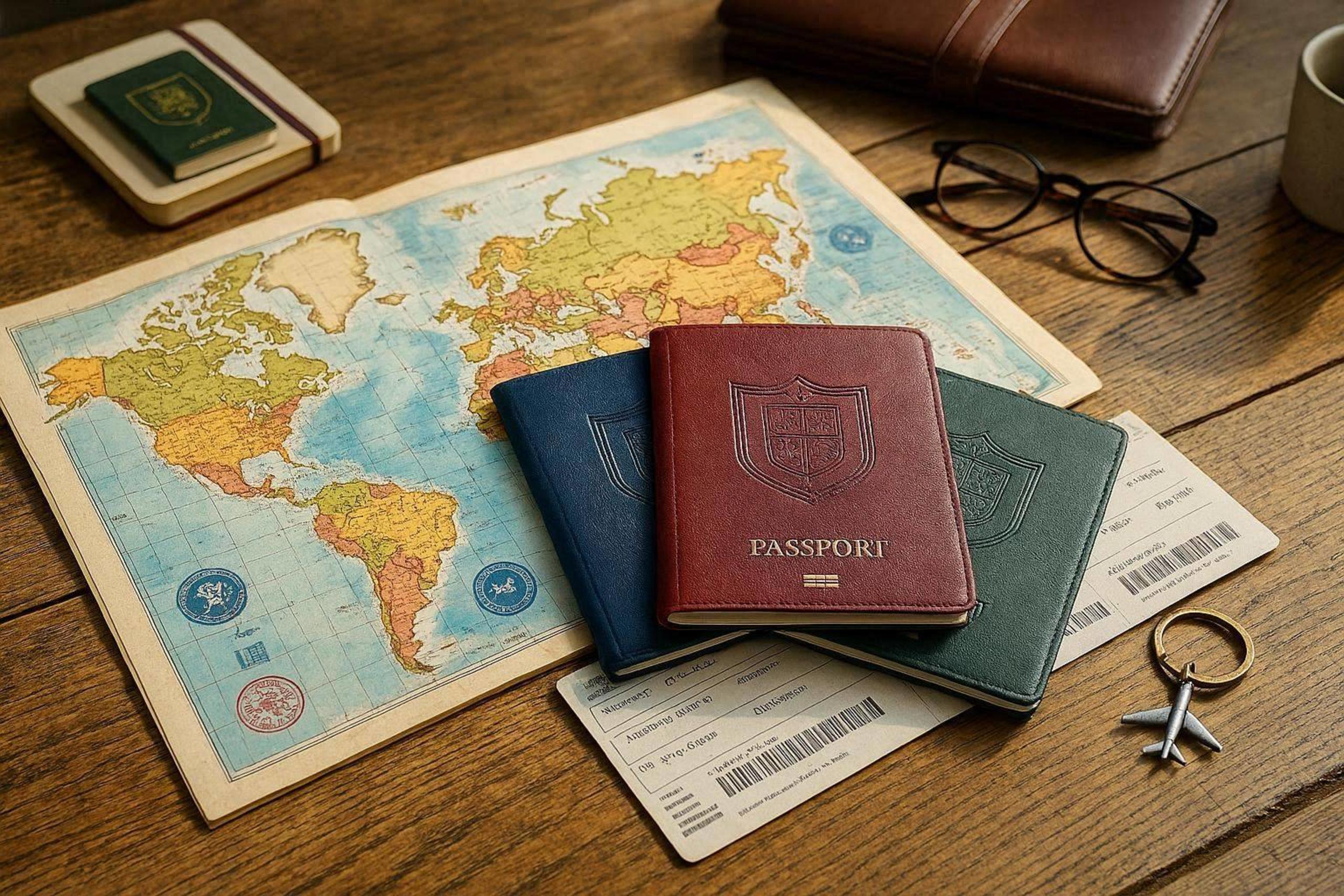
18. Passport colour is not random — it follows broad geopolitical and cultural traditions. Most passports fall into four colour families: red (EU member states, many post-Soviet countries, ECOWAS African nations), blue (USA, Canada, Australia, many South American nations), green (most Muslim-majority countries), and black (a handful including New Zealand, Botswana, Zambia — often for practical visibility reasons, and because black covers hide dirt and wear better). The EU has standardised its passport to burgundy-red with gold lettering, which is why all EU passports look similar in colour despite being issued by different governments with different designs.
✈️ Ready to Use Your Passport? Find the Best Flights:Compare hundreds of airlines for every destination your passport can reach — from visa-free escapes to bucket-list long-haul. Set price alerts and book when fares drop.
Search Flights Worldwide on Skyscanner →
🚧 Bizarre Border & Crossing Facts
19. There is a village in Europe where the border runs through the middle of houses — and residents need a passport to walk from their bedroom to their kitchen. The Belgian–Dutch border around Baarle-Nassau and Baarle-Hertog is one of the world's most convoluted: the Belgian municipality of Baarle-Hertog consists of 24 separate land parcels completely surrounded by Dutch territory, and the Dutch municipality of Baarle-Nassau has several enclaves entirely within the Belgian enclaves. The result: some buildings sit on the border, with their front door in one country and their back door in another. Before Schengen, residents of these buildings technically crossed an international border to walk between rooms. Today Schengen has made the border invisible in practice, but the official territory lines are still marked on the ground with crosses and street markers.
20. North Korea is the only country in the world where its own citizens need a permit to travel domestically. North Korean citizens require government permission not just to travel internationally (effectively impossible for most) but also to travel between cities domestically. Movement is restricted by a residence registration system called the songbun system, which assigns citizens to one of 51 social categories based on family political history. Pyongyang, the capital, requires special permission to visit or reside. Meanwhile, only approximately 6,000 foreign tourists visit North Korea annually — in guided groups, under constant supervision, with access restricted to approximately 15 approved sites.
21. There is a passport that gives access to zero countries — the UNLP (United Nations Laissez-Passer). The UNLP is a travel document issued to senior United Nations officials and staff. It is not a visa or passport in the conventional sense — it is a courtesy document that entitles the holder to diplomatic courtesies at borders. In theory, 173 countries have agreed to accept it as a travel document. In practice, recognition varies enormously and most border agents have never seen one. Many UNLP holders also carry their national passport as backup. The UNLP is dark blue with gold UN emblem and is issued in English and French.
22. The world's most-crossed land border — USA–Canada — sees approximately 400,000 crossings every single day. The US–Canadian land border is the longest international border in the world at 8,891 km and has the highest daily crossing volume: approximately 400,000 border crossings per day across 119 official crossing points. The busiest crossing (Detroit–Windsor Ambassador Bridge) alone handles around 25% of all Canada–US trade by value. Post-COVID, crossing times at major crossings have increased due to pre-clearance requirements and enhanced screening. Despite being one of the world's most open borders between two friendly nations, it generates more crossings than any other international border on Earth.
23. Having an Israeli stamp in your passport used to prevent entry to 16 Arab and Muslim-majority countries — and some still enforce this. For decades, a passport containing an Israeli entry stamp was grounds for automatic refusal of entry to Saudi Arabia, Kuwait, Yemen, Syria, Iraq, Lebanon, and others. Israel began issuing a separate slip of paper (rather than stamping passports) specifically for this reason. The Abraham Accords (2020) normalised relations between Israel and the UAE, Bahrain, Morocco, and Sudan — and those countries now accept Israeli stamps and passports freely. However, Lebanon, Iraq, Syria, Kuwait, and Yemen still officially refuse entry to passports with Israeli stamps, though enforcement varies.
🛡️ Travel With Confidence — Always Carry Travel Insurance:Visa-on-arrival and e-visa countries often have limited medical infrastructure. Travel insurance covers medical emergencies, trip cancellation, and unexpected rebooking — from as little as $1.50 per day.
Get a Travel Insurance Quote from SafetyWing →
📉 The World's Most Restricted Passports
24. Afghan passport holders can visit fewer than 30 countries without a visa — less than 15% of the world. Afghanistan's passport consistently ranks at or near the bottom of the Henley Passport Index, with visa-free access to approximately 28 destinations as of 2025. The restriction is a combination of geopolitical isolation, high perceived overstay risk (which causes countries to maintain visa requirements), and limited diplomatic relationships following decades of conflict. The practical effect on ordinary Afghans is severe — even obtaining a visa for medical treatment, family visits, or education requires navigating lengthy, expensive processes with no guarantee of approval.
25. The passport gap between the most and least powerful passports is 165+ countries — the widest it has ever been in recorded history. A Japanese passport holder can visit 193 countries freely. An Afghan passport holder can visit approximately 28. The gap of 165 countries represents an enormous and widening inequality in global mobility — one that is entirely determined at birth by nationality. This gap has grown in recent decades as wealthy nations have added bilateral visa-free agreements with each other while simultaneously tightening restrictions from perceived high-risk source countries. The global mobility inequality is now greater than at any point since World War II.
26. North Korea's passport is theoretically among the least powerful in the world — but no reliable ranking exists because so few North Koreans travel. North Korean citizens cannot obtain a passport without government approval, and approval is granted to a tiny number of officials, athletes, and selected workers (many of whom are sent to work in Russia and China under state labour contracts). Because so few North Koreans travel internationally, the practical "power" of the North Korean passport is nearly impossible to measure — few countries have formal bilateral agreements because the travel volume simply does not justify them.
27. A Pakistani passport can be cancelled by the government for travelling to Israel — and eight other specific countries. The Pakistani passport carries the statement "This passport is valid for all countries of the world except Israel." Pakistani law prohibits its citizens from travelling to Israel, and doing so is grounds for cancellation of the passport. Several other countries maintain similar restrictions: Kuwait prohibits travel to Israel, as do Libya, Syria, and Iran for various categories of travellers. This is separate from Israel's own entry restrictions — it is the home government restricting its own citizens from travelling to a specific destination.
🔮 The Future of Travel Documents
28. Digital passports — stored on smartphones — are already in use in 12+ countries for domestic travel. Australia, Japan, South Korea, and several EU countries now accept digital identity and travel credentials on smartphones for domestic and some international travel. The EU's Digital Identity Wallet, rolled out from 2024, allows EU citizens to store a digital version of their passport (eID) on their phone. The IATA (International Air Transport Association) has been developing a global digital travel credential standard since 2020. The practical barrier to universal adoption: not all countries have the border infrastructure to verify digital credentials, and the offline fallback for dead batteries or technical failures remains unresolved.
29. The fastest passport to obtain in the world — through a citizenship-by-investment programme — takes 45 days. The slowest takes 25 years. Vanuatu (Pacific island nation) offers the fastest passport through investment: citizenship can be obtained in approximately 45 days for a contribution of USD 130,000. In contrast, Switzerland requires 10 years of legal residence before applying for naturalisation — and the process can take a further 1–3 years, making it one of the world's most restrictive. Austria requires continuous legal residence of 10 years, active integration, and language proficiency, but offers one of the most valuable passports (full EU access) in exchange. Caribbean citizenship-by-investment programmes (St. Kitts, Grenada, Antigua, Dominica) offer strong passports in 3–6 months for USD 100,000–200,000.
30. One day, passport power may become irrelevant — if a proposed "universal visa" framework ever reaches critical mass. Several international organisations (including the UN and World Tourism Organisation) have proposed a global mobility framework that would gradually standardise entry rights across all countries — a kind of global Schengen agreement. In practice, the political barriers are enormous: sovereignty, security concerns, and economic migration fears have blocked every attempt. But smaller regional frameworks continue to expand: the ECOWAS (West Africa), ASEAN (Southeast Asia), and Caribbean Community agreements already allow free movement within their regions. If these regional zones continue to integrate, the world in 2100 may look significantly more Schengen-like than it does today.
🗺️ What These Facts Mean for Your Next Trip• Know your actual visa-free count before you plan — it changes every year
• E-visas have made dozens of "difficult" destinations easy to access in minutes
• Travel insurance is especially important in countries where you enter on-arrival or with an e-visa — medical evacuation coverage is essential
• For the best visa-free destinations from your passport: check our full passport guide
• Not sure if you need a visa for your destination? use our free Visa Checker ✈️ Start Planning Your Visa-Free Trip:
Search flights to every destination your passport can reach without paperwork — compare hundreds of airlines, set price alerts, and lock in the best fare.
Search Flights on Skyscanner → 🎟️ Book Experiences at Your Destination:
From Japanese temple tours to UAE desert safaris, Singapore city explorations to New Zealand fjord cruises — thousands of guided experiences worldwide, bookable in advance.
Browse Experiences Worldwide on GetYourGuide →
*Some links on this page are affiliate links. If you book through them, we may earn a small commission at no extra cost to you. This helps us keep the site free and the guides coming.