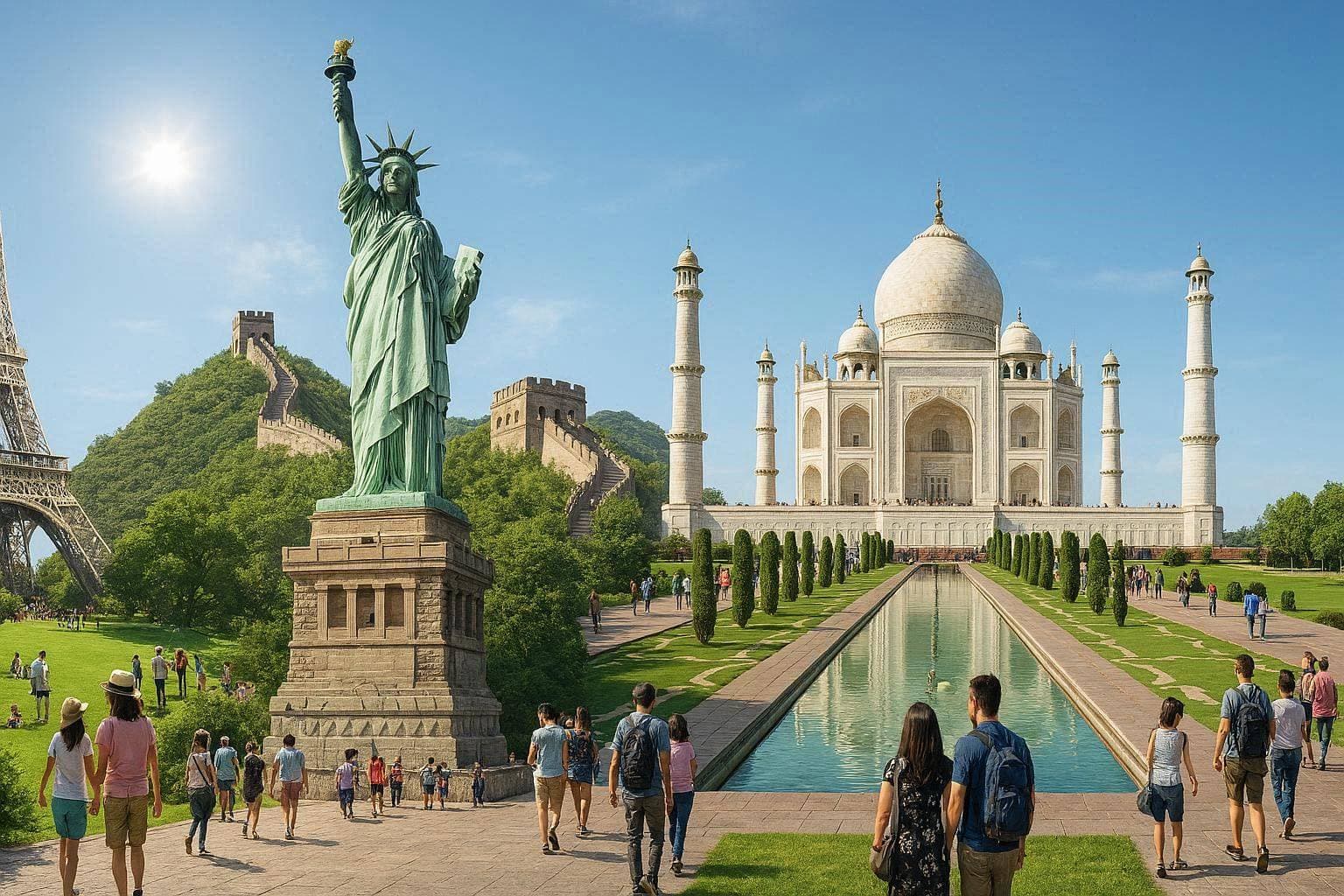
You have seen the photos a thousand times. You may have stood in front of them. But the most famous landmarks on Earth carry secrets that never make it into the brochures — engineering feats that defied the physics of their era, origin stories that could have gone entirely differently, and maintenance realities that make modern skyscrapers look simple. These 20 verified facts about the world's most famous landmarks are not trivia. They are windows into how these places were actually built, why they still stand, and what you will see differently next time you visit.
Each fact is contextualised — not just "what," but why it matters and what it means if you ever go.
🏛️ Quick Landmark Scorecard — How Many Did You Know?• 0–4: The landmarks have been holding out on you
• 5–10: Solid general knowledge. These will fill the gaps.
• 11–16: You have clearly done your reading
• 17–20: Are you an architect or just extremely curious?
🗼 Towers and Skyscrapers
1. The Eiffel Tower grows by up to 15 centimetres in summer. The tower is built from approximately 7,300 tonnes of wrought iron. When Paris temperatures climb toward 40°C in July and August, iron expands — and the top of the tower shifts upward by up to 15 cm. In winter it contracts by the same amount. The tower also sways up to 9 cm in strong wind, entirely by design — Eiffel's engineers built in controlled flex to distribute stress rather than fight it. This is why the tower has never needed structural repair in over 135 years. The 18-metre flagpole at the very top was partly decorative and partly a flexible buffer for these thermal cycles, calculated by hand by Eiffel's team.
2. The Empire State Building has its own ZIP code — and was nicknamed the "Empty State Building" for years. The Empire State Building receives so much mail and houses so many companies that the US Postal Service assigned it its own ZIP code: 10118. During construction in 1930–31, a peak of 3,400 workers were on site daily, completing 4.5 floors per week. The entire structure was finished in 410 days — still one of the fastest major skyscraper constructions ever. The irony: for its first decade, the building could not fill its offices during the Great Depression. New Yorkers called it the "Empty State Building." Profitability finally arrived in the 1950s when a broadcast antenna was installed on the roof and TV networks paid to use it — transforming a real estate liability into a communications hub.
3. "Big Ben" is not the name of the clock — or the tower. Big Ben is the nickname of the main bell inside the Elizabeth Tower at the Houses of Parliament in London. The tower was called the Clock Tower until 2012, when it was renamed the Elizabeth Tower for Queen Elizabeth II's Diamond Jubilee. The clock has four faces, each 7 metres in diameter, with 4.27-metre copper minute hands. Its legendary timekeeping accuracy — within seconds over 160 years — is maintained by adding or removing pre-decimal penny coins to the pendulum. Each coin shifts the rate by 0.4 seconds per day. The clock stopped for the first time in its 160-year history in 2017 for conservation works — and the silence prompted a genuine national conversation about identity.
🎟️ Skip the Queue at London's Iconic Landmarks:Book timed entry for the Houses of Parliament tour, Tower of London, and more — sold out slots are common in summer.
Browse London Landmark Tickets on GetYourGuide →
🏛️ Ancient Wonders and Historic Sites
4. The Colosseum had a fully retractable roof — operated by the Roman navy. The Flavian Amphitheatre (the Colosseum's formal name) held 50,000–80,000 spectators, and its shade system — called the velarium — was a canvas awning that could cover roughly two-thirds of the interior. It was rigged and operated by approximately 1,000 sailors from the Roman imperial navy, who climbed 240 stone corbels around the outer ring and handled the canvas sections the same way they handled sails — because it was essentially the same problem. No modern engineer has produced a functional replica without materials the Romans didn't have. The Colosseum also had 80 numbered entrances and a ticketing system that could empty 50,000 people in under 15 minutes — a crowd management design not matched by most modern stadiums.
5. The Great Pyramid of Giza was the world's tallest structure for 3,800 years. Built around 2560 BC with an original height of 146.5 metres, the Great Pyramid held the record as the tallest man-made structure until Lincoln Cathedral in England was completed around 1311 AD. That is nearly four millennia during which no civilisation built higher. The pyramid was originally clad in smooth white Tura limestone that reflected sunlight and could be seen from the Nile Delta, 100 kilometres away. Almost all of this casing was stripped in the 14th century to build Cairo's mosques and palaces. If you had visited in 2500 BC, you would have seen a blinding white structure with a polished gold capstone — nothing like the rough stepped stones visible today.
6. Stonehenge's inner stones were transported 250 kilometres from Wales — and we still don't fully know how. The famous bluestones at the heart of Stonehenge were quarried at the Preseli Hills in Pembrokeshire, Wales, and transported approximately 250 km to Wiltshire. The outer sarsen stones came from Marlborough Downs 40 km away and weigh up to 25 tonnes each. The debate about how the bluestones were moved — by raft along the coastline, by sledge across frozen ground, or by some combination of human effort and glacial movement — remains genuinely unresolved. Research published in 2021 identified a plausible ancient overland route matching glacial geology. Stonehenge was built and modified across multiple phases between roughly 3000 and 1500 BC — making it a 1,500-year construction project with no single architect.
🏛️ Visit Stonehenge and the Pyramids — Book in Advance:Both sites require pre-booked timed entry in peak season. Guided tours provide context that solo visits simply cannot.
Book a Stonehenge Guided Tour on GetYourGuide →
🌉 Bridges and Engineering Feats
7. The Golden Gate Bridge is repainted continuously — it is never "finished." San Francisco's Golden Gate Bridge requires permanent maintenance painting. A crew of roughly 38 painters works year-round — by the time they reach one end, the start needs attention again. The distinctive "International Orange" colour was chosen by architect Irving Morrow because it complements the Marin Headlands and remains visible in fog. The US Navy had wanted the bridge painted in black and yellow as a visibility aid. The Army Corps of Engineers proposed red and white stripes. Both were rejected. The towers (227 metres tall) were so high during construction that workers at the top experienced measurably lower air pressure and used supplemental oxygen — the first infrastructure project in the US to do so.
8. The Sydney Harbour Bridge is held together by 6 million hand-driven rivets. Completed in 1932, the bridge was assembled using 6,000,000 individual rivets — each one heated red-hot, thrown by hand to a catcher, placed in its hole, and hammered flush in seconds before it cooled. This required teams of four working in choreographed sequence at height, in the wind, over deep water. The two halves of the arch were built simultaneously from opposite shores; they met in the middle in August 1930 with a misalignment of less than 18 millimetres. All structural calculations were done entirely by hand. Sixteen workers died during construction — a lower per-capita fatality rate than comparable bridges of the era, due to early investment in safety equipment after an initial accident prompted a project-wide review.
🗽 Statues and Monuments
9. The Statue of Liberty was originally designed for Egypt. French sculptor Frédéric Auguste Bartholdi had initially conceived his colossal illuminated female figure — a robed woman holding a torch — as a lighthouse monument for the entrance to the Suez Canal, to be called "Egypt Carries the Light to Asia." Egypt declined due to cost, and Bartholdi adapted the concept as a gift from France to the United States, celebrating the ideals of liberty and the alliance forged during the American Civil War. The statue's face was reportedly modelled on his mother, Charlotte. The original torch — modified in 1916 to add glass windows, which caused water to leak into the arm — was replaced in 1986 with a gold-leaf replica. The original is now on display inside the museum at the base.
10. Christ the Redeemer was struck by lightning 3–4 times per year before modern protection. Standing at 710 metres above sea level on Corcovado Mountain, with outstretched arms making it one of the highest and most exposed points in Rio de Janeiro, the statue attracted lightning strikes several times every summer storm season before a modern protection system was installed. The right thumb, head, and finger joints have all required restoration after lightning damage. The statue is not solid marble — it is reinforced concrete covered in over 6 million soapstone tiles, each cut to a triangular shape and applied individually by hand. The current system routes lightning through copper rods inside the statue and grounding cables down the mountain.
🎨 Museums and Cultural Icons
11. The Louvre was a fortress, a royal palace, and briefly a political prison — before it became a museum. Paris's Louvre began as a medieval fortress in the late 12th century, built by King Philip II to defend the city's western approach against Viking raids from the Seine. It was converted to a royal palace by Charles V in the 14th century. During the French Revolution, royalists were briefly imprisoned there. Napoleon used it to store looted artworks from across conquered Europe — some of which were never returned. The museum opened to the public in 1793, one of the world's first national public art museums. I. M. Pei's glass pyramid entrance, opened in 1989, was opposed by approximately 90% of Parisians when announced. Today it is one of the most photographed structures in France.
12. The Sagrada Família has been under construction since 1882 — and is expected to finish in 2026. Antoni Gaudí's basilica in Barcelona has been continuously under construction for over 143 years, making it one of the longest active construction projects in history. Gaudí himself worked on it from 1883 until 1926, when he was struck by a tram and died three days later aged 73. He is buried in the crypt. The Spanish Civil War set the project back severely — Gaudí's original workshop was burned and his plans partially destroyed. Modern architects used computer modelling to reconstruct the missing elements. The basilica received its official building permit only in 2019 — 137 years after construction began — after Barcelona's city council and the project finally agreed on compensation for land originally built without permission. The projected completion date of 2026 marks the centenary of Gaudí's death.
13. The Vatican Museums would take years to visit properly. The Vatican Museums span approximately 7 kilometres of corridors and rooms containing over 70,000 displayed artworks from a total collection of 150,000+ objects. Viewing each displayed piece for 60 seconds would require approximately 1,167 hours — roughly 48 continuous days without sleep or rest. The Sistine Chapel, the most visited room, receives 5.5 million visitors annually — over 10,000 on peak summer days. Michelangelo painted the ceiling in 1508–1512 while lying on scaffolding, complained throughout about physical pain and paint dripping in his eyes, and reportedly disliked the Pope for forcing him to do it. He was primarily a sculptor and considered painting a lesser art form. Pope Julius II essentially overruled him — and it became the most studied ceiling in Western art history.
14. The Taj Mahal changes colour four times a day — by design. Completed in 1653 as a mausoleum for Emperor Shah Jahan's wife Mumtaz Mahal, the Taj Mahal is built from white Makrana marble that shifts colour with the light. At sunrise it appears soft pink; in full daylight, brilliant white; in late afternoon, golden; in full moonlight, silver-blue. This optical behaviour was deliberately considered by the designers — the mausoleum was intended to be visited at multiple times of day. The Archaeological Survey of India now allows special full-moon night visits on the five evenings around each full moon. The marble has been gradually yellowing due to Agra's industrial air pollution; the government periodically applies mud-pack treatments to slow the discolouration.
🏗️ The Landmark That Almost Wasn't
15. The Eiffel Tower was supposed to be demolished after 20 years. Gustave Eiffel designed his tower as a temporary structure for the 1889 World's Fair in Paris, built to mark the centenary of the French Revolution. The original contract with the Paris City Council required the tower to be dismantled in 1909. Eiffel saved it by quietly arranging for a telegraph transmission antenna to be installed at the top — giving the structure genuine military and commercial value at a time when wireless communication was transforming European powers. In 1914, the antenna intercepted German military transmissions that directly contributed to the Allied victory at the First Battle of the Marne. By then, the tower was so beloved and profitable that demolition was unthinkable. The structure that Parisian artists had called "a blot on the city" and "an iron monstrosity" became the world's most-visited paid attraction.
✈️ Which Landmark Is on Your List?• Eiffel Tower at night — free to watch the sparkle from Trocadéro
• Colosseum with underground access — book the Arena Floor tour
• Taj Mahal at sunrise or full moon — the most photogenic times
• Sagrada Família before the centenary crowds — 2026 is the year to go
• Stonehenge at dawn — English Heritage runs special solstice access ✈️ Find the Best Flights to These Landmarks:
Paris, Rome, Agra, Rio, London — compare hundreds of airlines and find the best price for your dates.
Search Flights Worldwide on Skyscanner → 🎟️ Book Landmark Experiences Before They Sell Out:
Colosseum underground access, Eiffel Tower summit, Sagrada Família timed entry, and Taj Mahal sunrise tours all require advance booking in peak season.
Browse Landmark Tours on GetYourGuide →
*Some links on this page are affiliate links. If you book through them, we may earn a small commission at no extra cost to you. This helps us keep the site free and the guides coming.