Argentina eats like no other country in South America. This is a nation where dinner starts at 10pm, where a wood-fired grill (the parrilla) is treated with the reverence other cultures reserve for religion, and where sharing a gourd of bitter mate tea is a bigger act of trust than sharing a meal. Argentina's food culture was shaped by the vast cattle ranches of the pampas, waves of Spanish and Italian immigration, and one of the world's great wine regions in the shadow of the Andes. The result is a table built around world-class beef, Malbec wine, and a genuinely obsessive sweet tooth for dulce de leche.
This guide covers the essential Argentine foods and drinks you need to try, where to find the best versions in Buenos Aires and beyond, what everything costs in 2026, and how to eat like a local rather than a tourist. For the wider picture, see our full Argentina travel guide.
| Quick Facts | Details |
|---|---|
| Currency | Argentine Peso (ARS) — always check the current "blue dollar" exchange rate before your trip |
| Street snack (empanada) | USD 1–2 each |
| Parrilla dinner for one | USD 12–25 with a glass of Malbec |
| Meal times | Lunch 1–3pm | Dinner 9–11pm (restaurants often don't open before 8pm) |
| Tipping | 10% at sit-down restaurants; not expected at cafés or for takeaway |
| Tap water | Safe to drink in Buenos Aires and most major cities |
Argentina's Food Culture in a Nutshell
Argentine cuisine is the product of two dominant forces. The first is geography: the pampas — one of the largest expanses of fertile grassland on Earth — produce grass-fed beef of exceptional quality, which is why beef sits at the centre of the national diet. The second is immigration: between 1880 and 1950, millions of Italian and Spanish immigrants settled in Argentina, which is why Buenos Aires has more pizzerias and pasta houses per capita than almost anywhere outside Italy, and why medialunas (mini croissants) and espresso-based café culture run just as deep as beef and wine.
Eating in Argentina is also intensely social. The asado is a weekend ritual that can last four or five hours, mate is passed around a circle of friends rather than drunk alone, and dinner reservations before 9pm mark you out as a tourist. Budget extra time for meals here — nobody rushes a table in Argentina.
1. Asado — Argentina's Barbecue Ritual
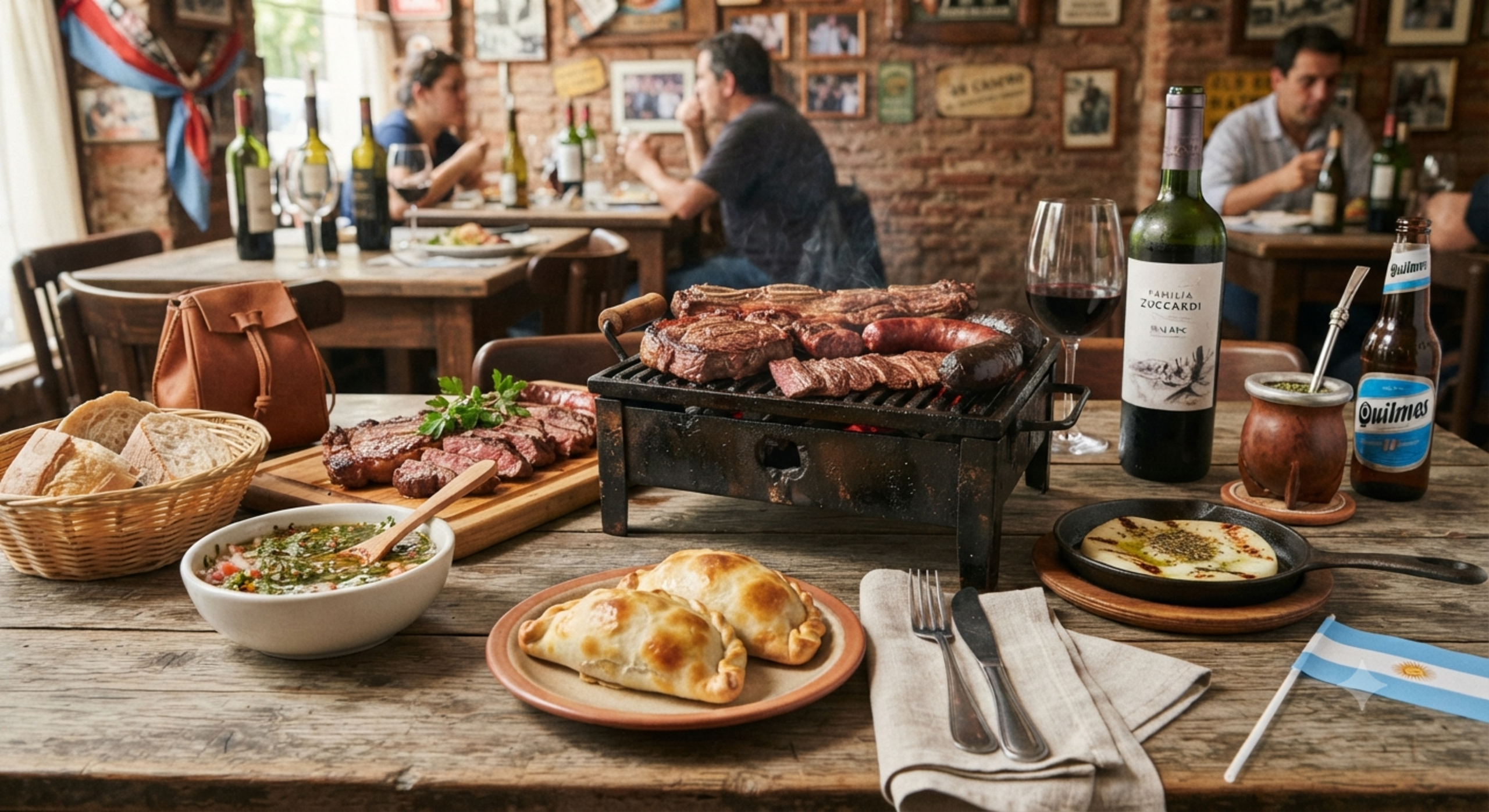
The asado is Argentina's greatest cultural institution: a slow ritual of grilling meat over wood or charcoal embers — never gas — that can run four to five hours and anchors every family gathering and celebration. The parrillero (grill master) presides with total authority over the fire. Classic cuts include bife de chorizo (sirloin), vacío (flank steak), entraña (skirt steak), tira de asado (short ribs), and morcilla (blood sausage), all served simply with chimichurri and red wine. For a deeper look at Argentina's steakhouse culture and the best parrillas in Buenos Aires, see our guide to Argentine beef and parrilla culture.
Where to eat: Don Julio (Palermo, Buenos Aires) for a world-renowned parrilla experience; La Brigada (San Telmo) for a classic, old-school asado; any neighbourhood parrilla with a queue of locals outside on a Sunday.
Price range: USD 15–25 at a neighbourhood parrilla | USD 35–60+ at a top-tier Palermo steakhouse.
Pro tip: Argentines eat their beef medium to well-done. Asking for it rare (jugoso) is completely accepted at good restaurants — just say so when you order.
2. Empanadas
Empanadas are Argentina's greatest snack — folded and crimped pastry cases filled with spiced minced beef, chicken, ham and cheese, or spinach and ricotta, then baked or fried. Every province has its own crimping style and filling: Salta's are small and juicy with boiled egg and potato; Tucumán's are tiny and deep-fried; Buenos Aires versions are larger and baked. Ordering a dozen empanadas with a bottle of Malbec is one of Argentina's most satisfying, least expensive meals.
Where to eat: El Sanjuanino (Recoleta, Buenos Aires) for classic baked empanadas; any panadería (bakery) or rotisería for a quick, cheap lunch.
Price range: USD 1–2 per empanada at a bakery | USD 10–15 for a dozen to go.
3. Provoleta
Provoleta is the classic opening act of any parrilla meal: a thick slab of provolone cheese grilled directly on the coals until the outside is charred and blistered and the inside turns molten, then finished with oregano and chili flakes. It arrives sizzling in its own cast-iron dish, often with crusty bread for scooping up the melted cheese. Ordering provoleta while the main cuts of meat rest on the grill is standard practice at any proper asado.
Where to eat: Any traditional parrilla in Buenos Aires or Mendoza — it appears on almost every steakhouse menu as a starter.
Price range: USD 6–10 as a shared starter.
4. Milanesa
Milanesa is Argentina's most-ordered everyday dish — thin slices of beef or chicken pounded flat, crumbed in seasoned breadcrumbs, and fried or baked. Milanesa a la napolitana comes topped with tomato sauce, ham, and melted cheese; milanesa al pan (in a bread roll with tomato and mayo) is the country's favourite sandwich. Every Argentine family makes milanesas at least once a week — it's the comfort food Argentines abroad miss the most.
Where to eat: El Preferido de Palermo for a classic sit-down version; any casa de comidas (home-style diner) for a cheap, generous plate.
Price range: USD 5–10 for a full plate with a side.
5. Locro
Locro is Argentina's great national stew — a thick, slow-cooked mix of white corn, beans, squash, and pork or beef, traditionally eaten on national holidays like May 25 (Revolution Day) and July 9 (Independence Day). It's hearty, filling, and deeply regional: northern Argentina, particularly Salta and Jujuy, makes the most authentic versions, often with a spicy salsa criolla stirred through at the table. Locro is winter comfort food, rarely found on menus in the height of summer.
Where to eat: Family-run restaurants in Salta and Jujuy; in Buenos Aires, look for it on menus specifically around national holidays.
Price range: USD 6–12 for a generous bowl.
6. Chimichurri
Chimichurri is Argentina's essential condiment — a vibrant, uncooked herb sauce of finely chopped parsley, dried oregano, garlic, chili flakes, olive oil, and red wine vinegar, made fresh for every asado. It accompanies virtually every grilled meat in the country, and every family and parrilla chef guards their own recipe with real pride. A good chimichurri should be herby, garlicky, and slightly acidic — the essential counterpoint to Argentina's rich, fatty beef.
Where to eat: Served free alongside grilled meat at every parrilla in the country.
Price range: Included with meat orders; jars for USD 3–5 at any supermarket to take home.
7. Dulce de Leche
Dulce de leche is Argentina's most beloved ingredient — a thick, golden caramel cream made by slowly heating sweetened milk until it turns into something between toffee and custard. It's spread on toast, drizzled over pancakes, layered inside cakes, sandwiched inside alfajores, and eaten straight from the jar with a spoon. It appears in virtually every Argentine dessert and bakery item, and Argentines are evangelical about it — rightly so.
Where to eat: Every bakery and supermarket in the country; Havanna cafés for a polished, gift-ready version.
Price range: USD 2–4 for a jar at a supermarket.
8. Alfajores
Alfajores are Argentina's iconic biscuit sandwich — two soft, crumbly shortbread rounds joined by a thick layer of dulce de leche and rolled in desiccated coconut or coated in chocolate. They're eaten at every time of day: at breakfast with coffee, as an afternoon snack (merienda), and as gifts to bring home. Havanna is the most famous brand nationwide, but regional versions from Córdoba and Mar del Plata are considered the finest.
Where to eat: Havanna (nationwide chain); artisanal bakeries in Mar del Plata and Córdoba for the best versions.
Price range: USD 1–3 per alfajor.
Pro tip: Buy alfajores at a supermarket rather than an airport gift shop — you'll pay half the price for the same box.
9. Medialunas & Café Culture
Buenos Aires runs on coffee and medialunas — buttery, glazed croissant-style pastries, smaller and sweeter than their French cousins, eaten for breakfast and merienda. The city's café culture is extraordinary: historic confiterías like Café Tortoni, open since 1858, have been gathering places for over a century. Order a cortado (espresso with a splash of milk), two or three medialunas, and settle in to watch porteño life unfold.
Where to eat: Café Tortoni (Buenos Aires, since 1858) for the full historic experience; any neighbourhood café for an everyday version.
Price range: USD 3–6 for coffee and medialunas.
10. Mate
Mate is Argentina's national drink and a genuine social ritual — a bitter infusion of dried yerba mate leaves drunk from a hollowed gourd through a metal straw (bombilla). Sharing mate is an act of friendship: the same gourd is passed continuously around a circle, and each person drinks until it runs dry before passing it back. Argentines carry a mate thermos everywhere — on buses, at work, in parks. Turning down a shared mate is considered genuinely awkward.
Where to try it: You won't find mate on restaurant menus — it's a home and park ritual. Buy a gourd and bombilla from any supermarket or souvenir shop and ask a local to show you the proper technique.
Price range: USD 8–20 for a basic gourd and bombilla set; yerba mate itself costs USD 3–5 per bag.
11. Argentine Malbec & Wine Country
Argentina is the world's leading producer of Malbec, the deep, full-bodied red grape that found its greatest expression in the high-altitude vineyards around Mendoza. Argentine Malbec is richer and more structured than its French Cahors ancestor, with notes of plum, blackberry, and violet. The Luján de Cuyo and Maipú regions produce the finest examples, and wine tours from Mendoza — including bicycle vineyard tours and tastings with Andean backdrops — are among the best in South America.
Where to drink: Any bodega (winery) in Luján de Cuyo or Maipú, Mendoza; wine bars in Palermo, Buenos Aires, for a city-based tasting.
Price range: USD 4–10 per glass at a wine bar | USD 15–60+ for a bottle at a bodega, depending on vintage.
12. Fernet con Coca
If Malbec is Argentina's refined drink, Fernet con Coca is its beloved everyday one — particularly in Córdoba, which drinks more Fernet-Branca per capita than almost anywhere on Earth. The bitter, herbal Italian liqueur is mixed roughly 70/30 with Coca-Cola and served in a tall glass over ice. It's the default order at bars, barbecues, and birthday parties across the country, and Argentines take their exact ratio seriously.
Where to drink: Any bar in Buenos Aires or Córdoba — it's on every drinks menu, often by the litre for a group.
Price range: USD 4–8 per glass at a bar.
Buenos Aires and Mendoza are two of South America's best food and wine destinations. A guided food tour or a Mendoza vineyard day trip is the fastest way to taste widely without guesswork.
Buenos Aires Food & Wine Tours on GetYourGuide | Argentina Food & Wine Experiences on Viator
Best Time to Visit Argentina for Food & Wine
Argentina's food calendar is worth planning around. The Vendimia grape harvest festival takes over Mendoza every March, celebrating the year's Malbec harvest with tastings, parades, and an enormous open-air theatrical show. Asado season runs year-round, but the best outdoor grilling weather in Buenos Aires falls in the shoulder seasons of October–April, when patios and rooftop parrillas are in full swing. Locro is most authentic — and most widely served — around the national holidays in May and July. Check our Argentina weather guide before booking to match your trip to the right season.
What It Costs to Eat in Argentina
| Meal type | Typical cost (USD) |
|---|---|
| Street empanada | USD 1–2 |
| Café coffee + medialunas | USD 3–6 |
| Neighbourhood parrilla dinner | USD 12–25 |
| Top-tier Palermo steakhouse | USD 35–60+ |
| Bottle of Malbec at a bodega | USD 15–60+ |
Argentina's inflation and dual exchange rates make budgeting a little different from most countries — always change money at official casas de cambio or via MEP dollar transfers rather than the official bank rate. For a full regional cost breakdown, see our Argentina cost of travel guide and the Buenos Aires budget guide, or run your own numbers with the travel budget calculator.
Getting Around & Where to Stay
Buenos Aires is walkable in the centre, with the Subte (metro) and buses covering the rest of the city cheaply. For everything else, use Cabify or Uber rather than hailing a taxi on the street — it's safer and avoids overcharging. If you're planning a longer stay to properly explore the food scene, our Buenos Aires digital nomad guide covers wifi speeds, SIM card options, and neighbourhood recommendations for a longer visit.
Palermo, San Telmo, and Recoleta put you within walking distance of the best parrillas, cafés, and wine bars in Buenos Aires.
Browse Buenos Aires Hotels on Booking.com →
Safety Tips for Eating Out in Argentina
- Tap water is safe to drink in Buenos Aires and most major cities — no need for bottled water at restaurants.
- Watch your bag and phone at outdoor cafés and markets, especially in San Telmo and La Boca, where petty theft targets distracted diners.
- Use registered taxis or rideshare apps to and from restaurants at night rather than hailing a cab on the street.
- Exchange money at official casas de cambio, not street money-changers (arbolitos), before a big night out.
- Check current entry requirements on our Argentina visa guide before you travel.
Plan Your Argentina Food Trip
Ready to build a full itinerary around Argentina's food and wine? Our 7-day Argentina itinerary balances Buenos Aires parrillas with a Mendoza wine detour, while the 3-day itinerary is built for a Buenos Aires-only food weekend and the 14-day itinerary adds Patagonia and Iguazú Falls to the mix. Foodies with more time should also consider crossing into neighbouring Uruguay, which shares Argentina's asado and mate traditions — see how the two compare in our Argentina vs Chile and Brazil vs Argentina guides if you're deciding where to go next.
Eating in Argentina: Practical Tips
- Dinner starts late: Restaurants rarely open before 8pm and locals eat at 9–11pm. Showing up at 7pm often means an empty, half-set dining room.
- Order to share: A parrilla meal is built around shared platters of meat, not individual mains — order for the table, not per person.
- Bring a friend for mate: It's rarely served to one person alone. If you're offered mate at a park or a home, drink the whole thing before handing it back.
- Ask for the "cuenta" to close out: Bills are almost never brought unprompted — you'll need to ask, sometimes more than once.
- Sunday is asado day: Many smaller businesses close, but parrillas are busiest — book ahead for a well-known spot.
Argentina's kitchen table is as essential to understanding the country as Iguazú Falls or the Patagonian ice fields — plan a few extra hours into every meal and you'll leave with a real feel for how Argentines actually live. For more on where to go next, browse our full Argentina travel guide or explore more PickNGoTravel guides for your next stop.